

Think you can't bake the most buttery, flaky pie crust home? Think again, because yes you can! Learn how to make the most perfectly flaky and tender all-butter pie crust in your own kitchen using a series of simple, easy folds, a technique called lamination. It's my secret for an ultra-flaky pie crust that's easy to work with, doesn't crumble, or leak. Made without vegetable shortening, my homemade pie crust has been tested, and perfected over many, many months. It's foolproof!
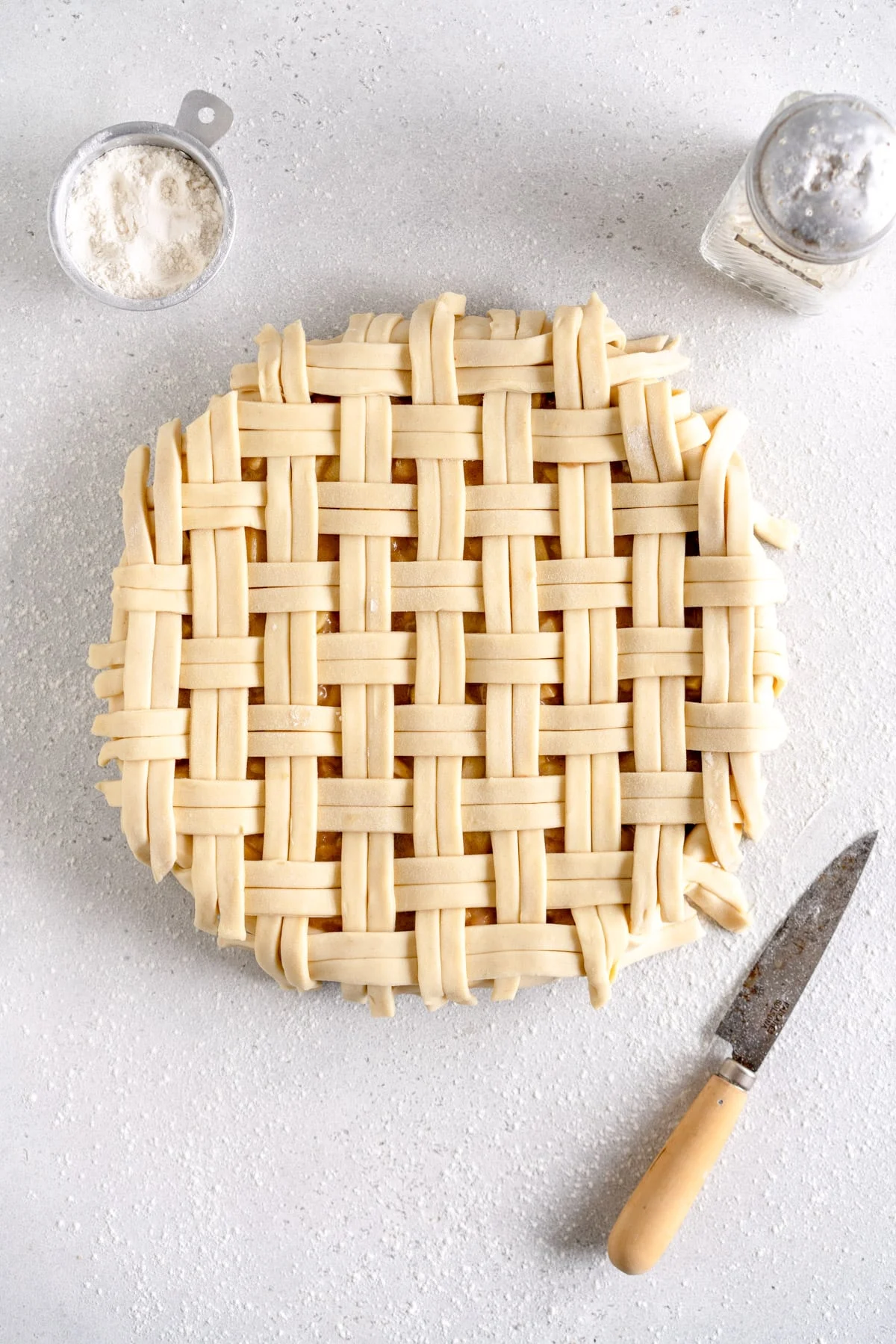
Hi hi! I am just popping in to share this ultimate guide to making your own homemade all-butter pie crust! Making pie dough from scratch can be a little intimidating.
But I promise with this guide as a resource and a couple of steps, we will have you making your own perfect pie crust in no time at all. Having one pie crust recipe is such a huge time saver. You can make it ahead of time, pop it into the freezer for later, and tick it off your list.
This is the entire inside of my brain on pie crust in one post, so buckle up - it may take a wee while to read but I promise that it is worth your time.
This is a bit of a resource, so I have broken down the post into the following sections - feel free to click on the sections which will jump you around the post.
- What you will learn
- Why I really rate this pie crust recipe
- Important ingredients and why I use them
- All butter pie crust vs shortening pie crust
- Making pie by hand vs using a food processor
- The secret to a flaky pie crust: Laminated pie dough
- Step-by-step instructions for all butter pie crust
- I screwed my pie crust up so you don't have to
If you have made pie crust before and it has flopped - this is the post for you. I’ve got you - and will hold your hand every step of the way, including touching on as many troubleshooting steps and possible pinch points as I possibly can to help you along the way.
Homemade pie crust is super easy to make once you get the hang of it. It is great to make in bulk and store ahead so that you have frozen pie dough ready to go whenever you need.
Pie dough that is easy to work with is a dream. It just takes a couple of sneaky extra steps to give you a super smooth, homogenous but flaky pie crust.
It settles well into the pie pan, and gives a lovely sturdy bottom crust. This is the go to method that I have been using for years and the recipe that I use to make detailed lattices. It works great for blind baking, par baking, and for baking sturdy double crust pies.
My sneaky step is a series of quick folds to the pie crust once it has been in the fridge resting for about an hour. This is a five minute step, but I promise that it makes such a huge world of difference and gives you pie crust that is super easy to work with and bakes up beautifully and flaky.


What You Will Learn
In this pie crust tutorial, we will cover allll of the basics that I have learnt / taught myself over the years of being a baking blogger, with step-by-step instructions.
I will cover ingredients that I use, how to mix the pie crust, how to perform the laminations, and how to store and freeze your pie crust for making ahead and using at a later date.
While it may seem like a lot of information, you are welcome to pick and choose what you need and what suits you! If you have questions please feel free to leave them in the comments section below and I will get back to you as soon as I can.
Making pie crust from scratch does take a little bit of practice, but I promise you that with practice comes confidence and you’ll be whipping up pies in no time at all!


Why I Really Rate this Pie Crust Recipe
I'm from New Zealand and when we say we 'rate' something - it means that we love it. I have been there- you are super excited to make pie, but get stuck on the most crucial part - a good crust.
I have made this all-butter pie crust hundreds of times, and I promise you, we can make it work for you.
There are a few steps but they are all super manageable and you can break up the workload, and you will be a super confident pie crust maker in no time! Here’s why I love this crust and I think you will too:
- Easy to make with no fancy equipment. This crust comes together with no fancy equipment, I just use my hands to make it.
- Super consistent. A huge benefit of weighing ingredients is that you can weigh the amount of water that you put into the pie crust, meaning you can make large quantities of the crust and have it all be the same consistency, so whether you’re using it from fresh or taking it from the freezer, you know it will work for you.
- Great to make ahead. I often make a bunch of pie crust all at once, and then store it in the freezer. Well wrapped it stores for up to 3 months and handles the same regardless of whether it is fresh or has been frozen.
- Super easy to work with and won't fall apart on you. I know that a lot of people get intimidated by pie crust - rolling it out, using it to make lattices or single crusts. The lamination step that I include in my recipe gives you a super homogenous dough that is still flaky and light, and really easy to work with - it works particularly well for things like lattices as it holds together so well.
- Minimal leakage in the oven. A big issue that people can have with their pie crust is that it leaks butter in the oven. This is usually because the crust hasn’t been properly mixed and the butter chunks are too large, meaning that the butter seeps out in the oven. The lamination helps to prevent this. It can also come from the butter chunks being too big and the pie crust also being too wet, meaning that it all flops in the oven and you end up with a pie crust that is both shrunken and has leaked butter.
- Blind Bakes like a dream. I love using this pie crust recipe for blind baking - it makes the process super easy and streamlined.
If you are after information on blind baking a pie crust, check out my post: How to blind bake pie crust for all my tips and tricks!

Important Ingredients and Why I Use Them
Pie crust doesn’t have that many ingredients, so it is important that you use ones that are of good quality.
This is where you splurge on the good butter - an all butter pie crust really sings with butter flavour.
- Butter. It’s not an all butter pie crust without all butter. No shortening here. I have made pie crust all around the world with all sorts of butters and they all work, but a good quality butter (one that people accuse you of being mustard, IYKYK), is good here. Make sure it is super cold though before you start working - butters with higher percentages of butterfat do get softer quicker and stay softer so you want them to be nice and cold.
- Flour. I use All-purpose flour (also called plain flour) for my pie crust. Gluten is a dirty word when it comes to making pie crust, so you want to use a lower protein content flour rather than something which develops more gluten like a bread flour / high grade flour.
- Salt. Just a wee bit - if you are using salted butter, you can leave it out.
- Apple Cider Vinegar. Adding vinegar to your pie dough helps prevent gluten formation and keep it tender. Some recipes will also use vodka. This is a totally optional addition, and you are welcome to use all water here if you like.
- Ice water. It is really important to keep everything nice and cold when you are making pie crust. Ice cold water helps with that.
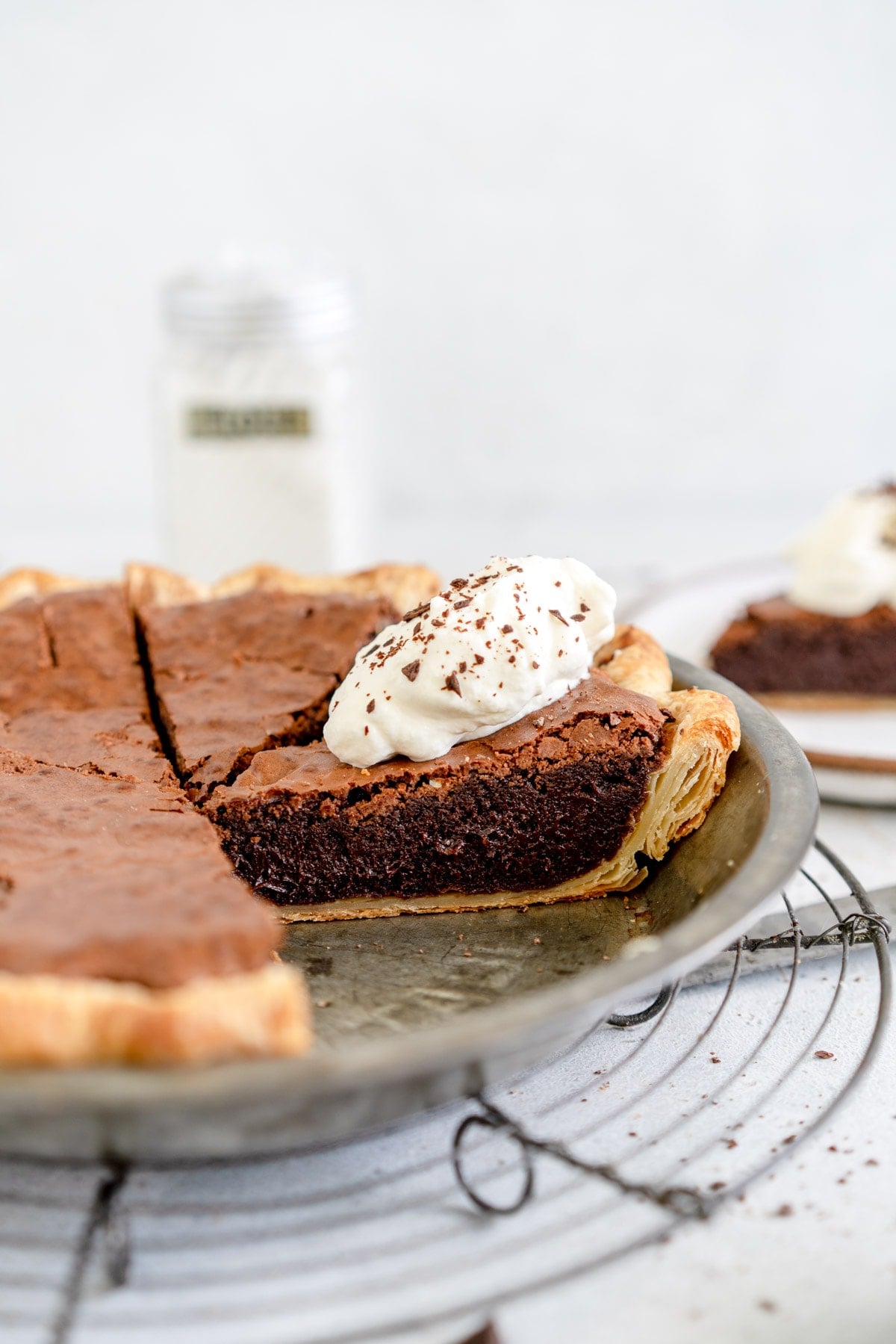
No Sugar In Your Pie Crust?!
If you have made my pie crust in the past you will notice that in the updated version, there is no sugar. I haven’t used sugar in my pie crust in years even though it is written in the recipe.
The reason why? I’m lazy. I often can’t be bothered getting it out of the cupboard, so I don’t. And the pie crust is great without it and I actually love how savoury it is, and also means I can grab a disc of dough from the freezer and use it for either a sweet or savoury pie.

All-butter pie crust vs Shortening Pie Crust
I make my pie crust using only butter as the source of fat. Other pie recipes may use shortening, or lard, or a mix of butter and shortening. I much prefer butter as it has an amazing flavor, and is something that I always have in the house.
I prefer to use unsalted butter for my pie crust recipe. It means that I can control the amount of salt in the recipe. If you only have salted butter this is fine too, just hold back on the added salt in your mixture.
Pie Crust by hand vs food processor
It is super common to make pie crust in the food processor. This method works great, and if you do it this way, go for it!
When you make the dough in the food processor you use the machine to pulse the butter into the flour, which serves the same purpose as shingling it in with your hands. However, I prefer to make it by hand for a few reasons:
- Much easier to get the moisture content right. When you are making pie crust by hand, you can see exactly how it is reacting to the water added, particularly toward the end of the process where you sprinkle in the water a tablespoon at a time. It is quite easy to accidentally over hydrate a pie dough made in the food processor, as you can't see or feel it coming together as well.
- You run the risk of over working the dough. Again, it is harder to see what is happening when you make pie crust in the food processor, so it is much easier to over work the crust by mistake, resulting in a tough crust.
- Cleaning the food processor sucks. That's all I have to say on that.
Pie making equipment
The thing I love about making pie crust from scratch is that it requires limited equipment - a digital scale is a must obviously, but aside from that you don't need many things!
- Mixing Bowl. I prefer something on the larger side so that nothing flicks out while I am working.
- Pastry Blender or pastry cutter. This is a totally optional tool. I know that some people love to use it, but I do my pie crust by hand. Either works here, the purpose of the blender or using your hands is to incorporate the butter into the flour.
- Plastic wrap. This isn't equipment as such, but it is important to have on hand to wrap the pie crust to prevent it from drying out. I have tried ziploc bags and other wrapping materials and nothing works quite as well.
- Rolling Pin. A pie making essential - my favourite rolling pin for making pie is a french style rolling pin.
The secret to a flaky pie crust - laminated pie dough.
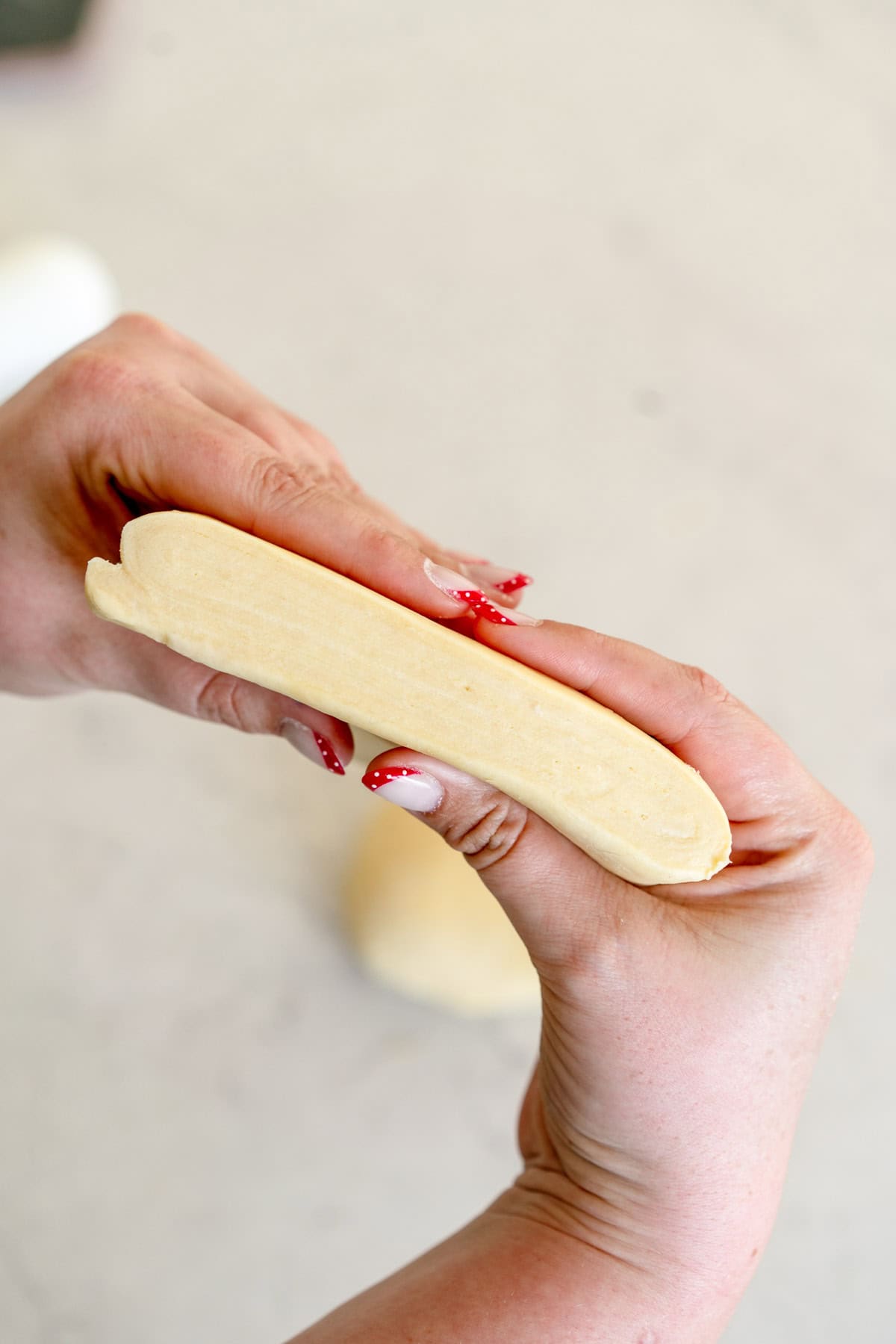
I use a little tip that my baking bestie Erin Mcdowell taught me - to laminate my pie dough after making it but before rolling it out for use. What this does it pops a few layers within the pie dough. This makes it homogenous and easy to work with but also still nice and flaky.The lamination is what makes my pie crust recipe really easy to work with. Lamination basically means giving the dough a series of folds, the same way that you would for a puff pastry.
I do my folds all in one go, after the pie dough has been mixed and rested in the fridge for about an hour. I do three rounds, then shape the dough into discs or the shape that you need.
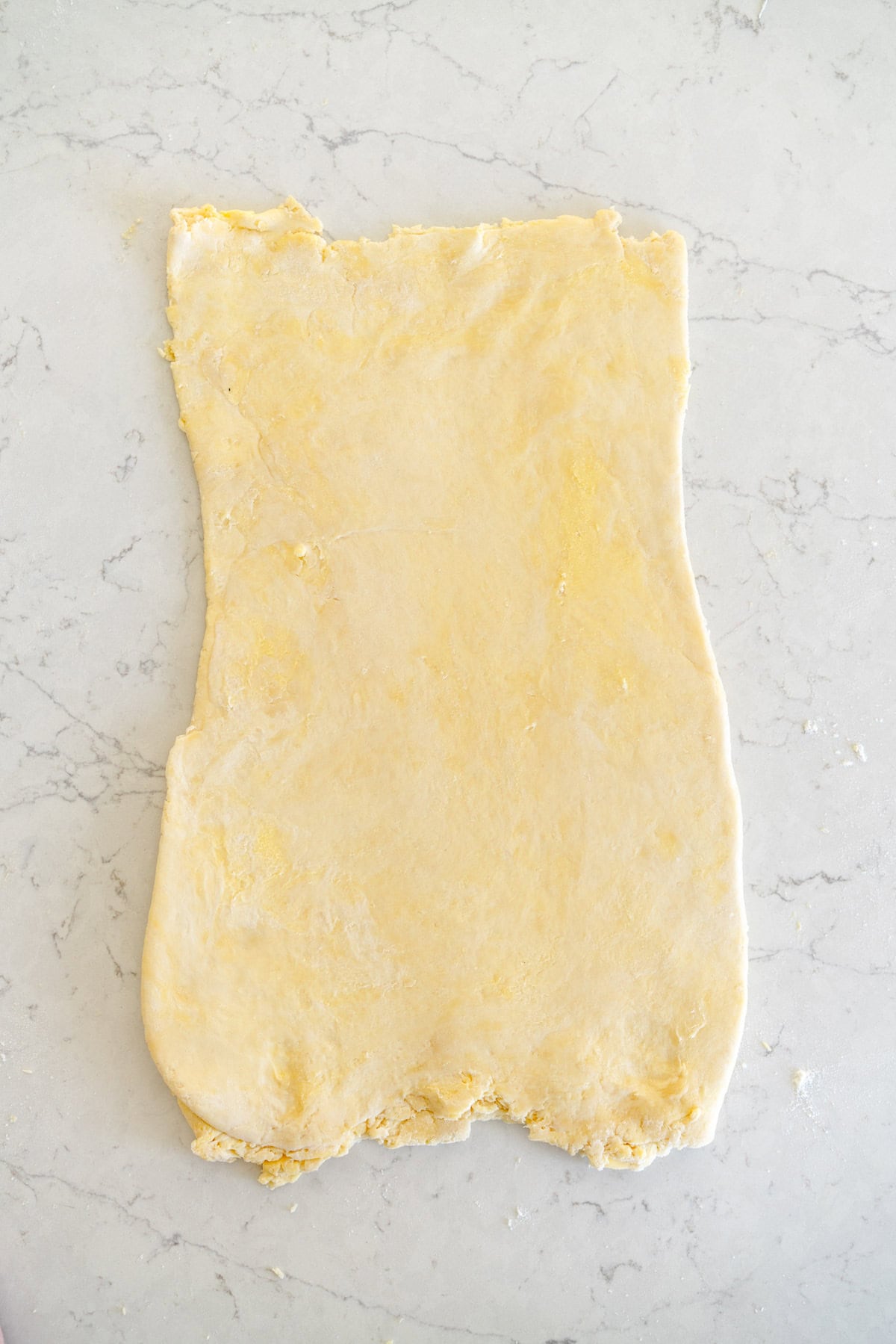
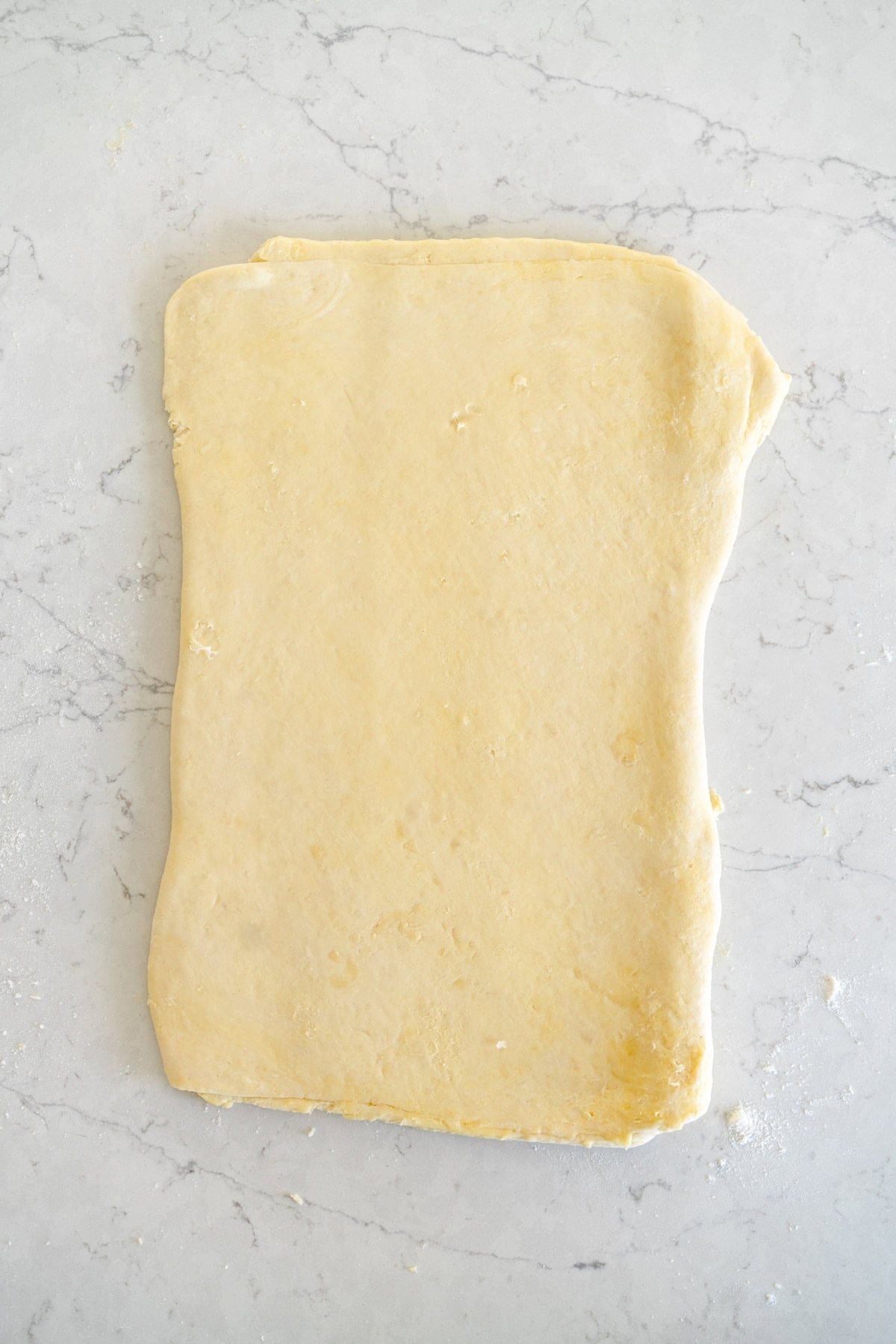
Laminating the pie crust is not kneading it - you are adding in layers. It makes the butter pieces smaller and in layers within the pie crust so that when it hits the hot oven, the butter will create steam, which in the tiny little layers, makes flakes in your pie crust. As I mentioned earlier, the pie crust is much less likely to leak butter in the oven as you don’t have large pieces of butter within the dough.
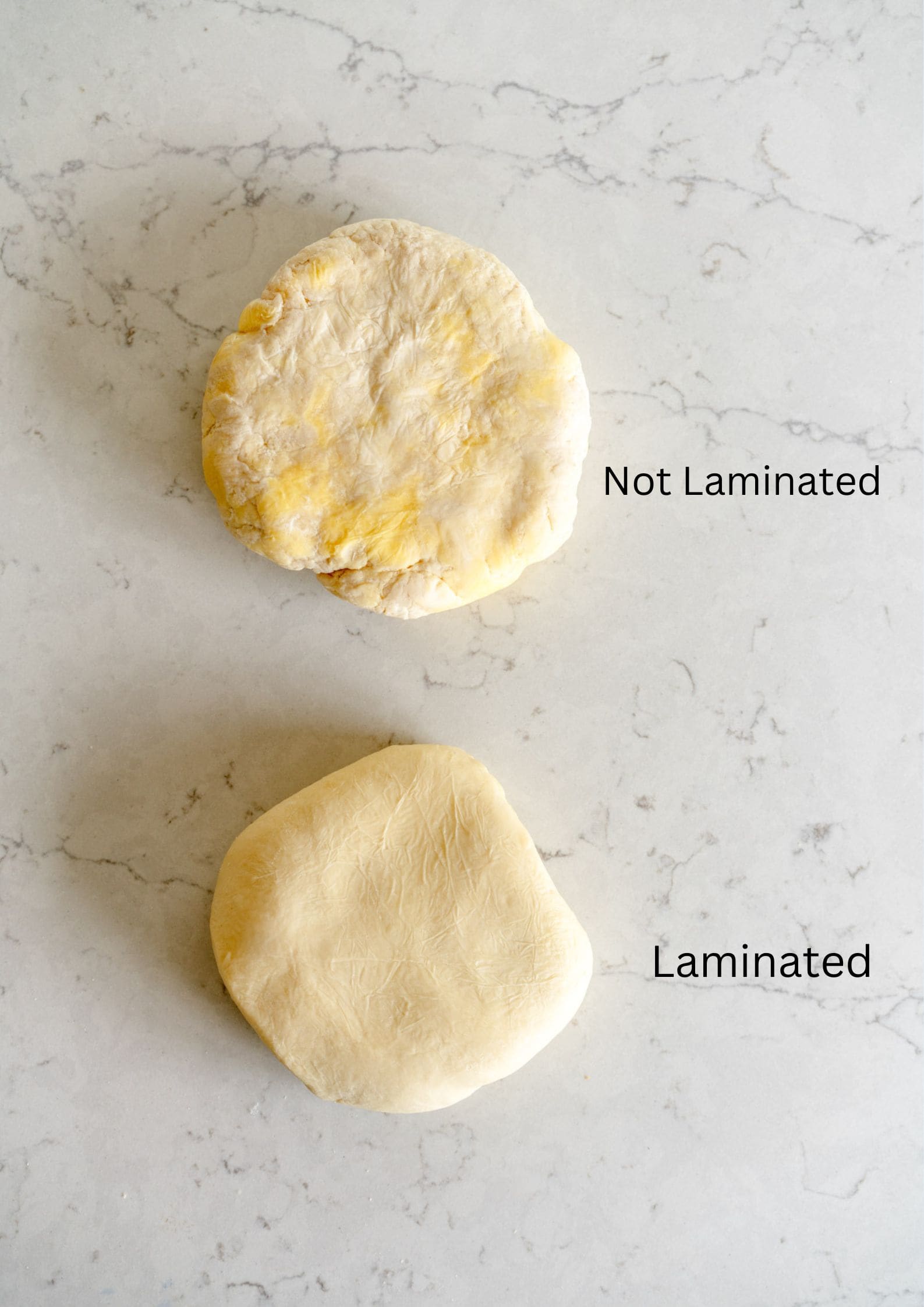
While laminating your pie crust is an optional step, I really recommend it, especially if you are new to pie crust. You can see in the image below the difference between the two crusts - the top one has not been laminated and still has large butter chunks, while the bottom one has had a series of laminations / folds performed, and is much more homogenous.
Step-by-step Instructions for all butter pie crust:
This may seem like a lot of steps but I promise you that once you get the hang of it you will be making homemade pie crust like a pro! Here are my top tips:
- Plan ahead. Pie crust works best if you are able to make it ahead of time so that it can rest overnight. The minimum rest period that it needs is 2 hours, but you will get best results if you are able to leave it to rest overnight.
- Keep everything cold. Make sure you have cold butter, and ice cold water. This helps to stop the butter from melting and means your dough is nice and easy to work with.
- Don't work it too much. Gluten is a bad word when it comes to making homemade pie crust. You don't want to develop too much gluten in the crust by over working it. Be gentle when mixing your liquid in. The laminations is adding folds to the dough rather than kneading it - like rough puff pastry.
Step 1: Cut your butter
You want to make sure that everything is kept super cold. If you are cutting up lots of butter, cut it and then pop it back into the fridge until you are ready to use. I like to cut mine into cubes - you can see in the image how large I cut them.
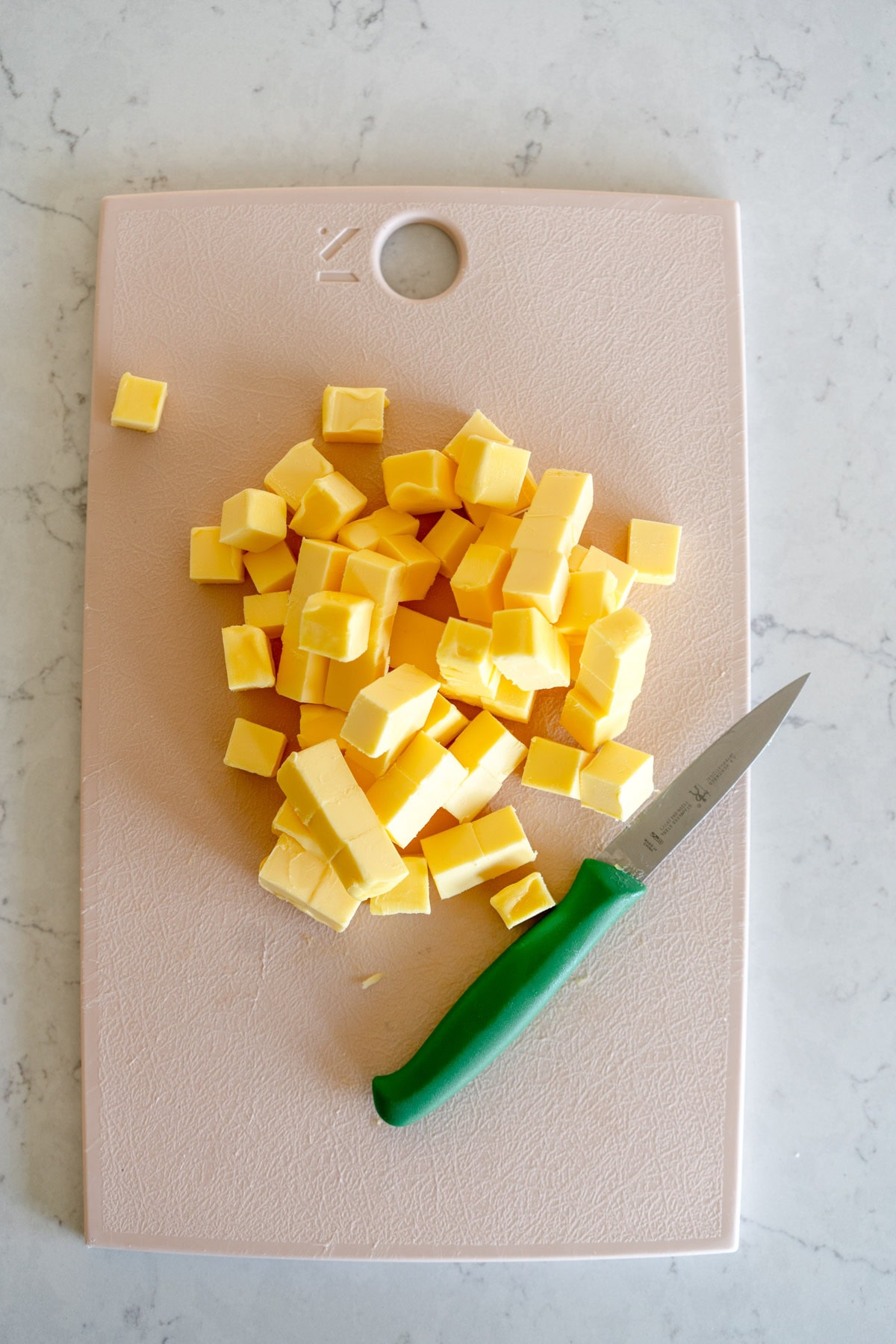
Step 2: Prepare your dry and wet ingredients
Weigh your flour and salt into the bowl, and fluff together to combine. Mix the ice, water, and apple cider vinegar together in a bowl or measuring jug. Note that you will have a little more liquid than you will use in the pie crust - if you are worried about wasting vinegar you can make up less of the mixture if you need to. If you are doubling the pie crust recipe, you may only need to make up one batch of the liquid.
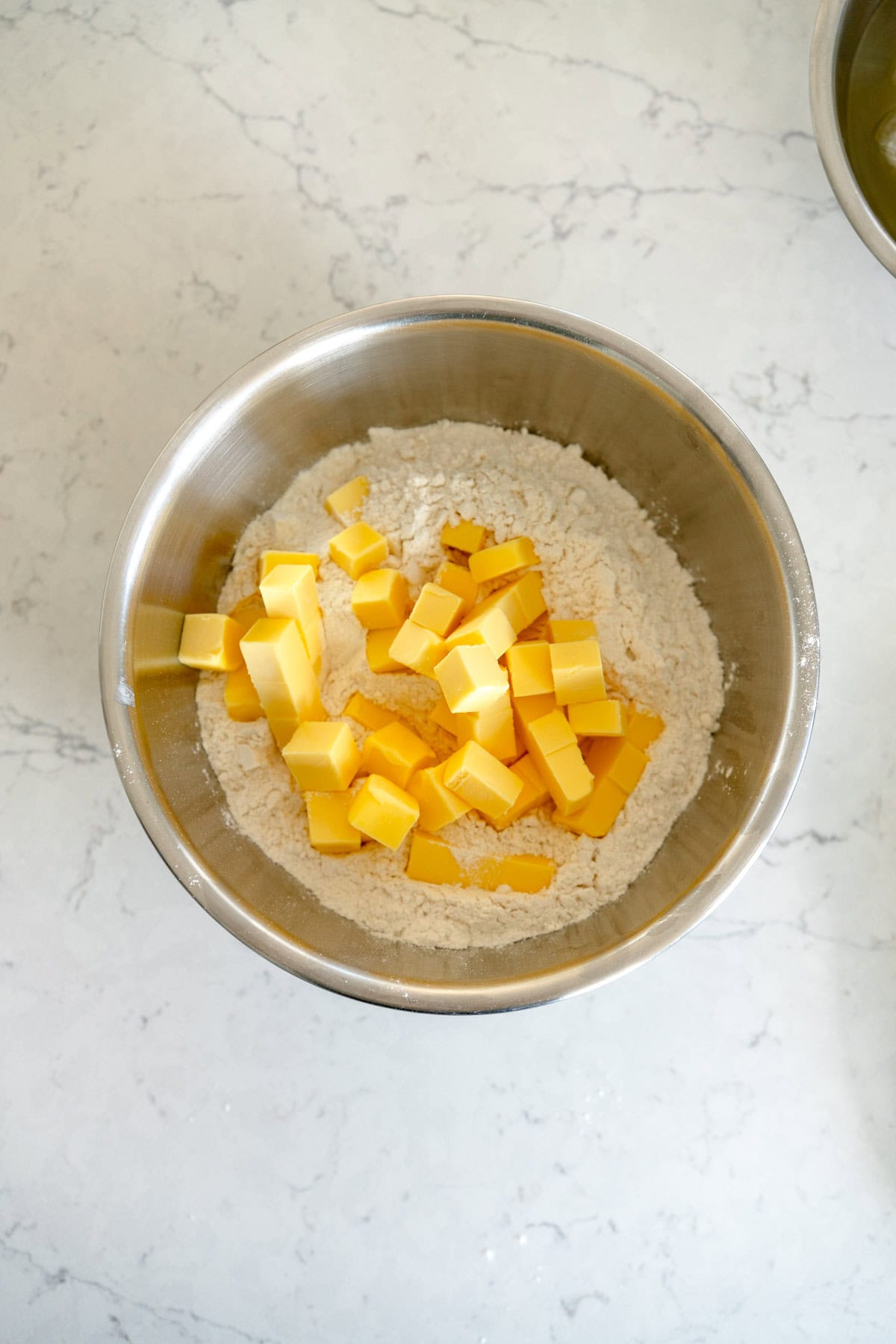
Step 3: Incorporate the butter
Add the butter to the flour bowl and toss it to combine so that each piece is covered in butter. Now you are going to use your fingers to incorporate the butter into the flour - you want to use your thumb and finger to squish the butter between them so that it flattens out into shingle shapes. I like to start with all the pieces of butter over one side of the bowl and as I flatten them, place them on the other side so I know which pieces have been done.
I find it necessary to only give each piece of butter one squish, but if you feel like it needs more, by all means go ahead.
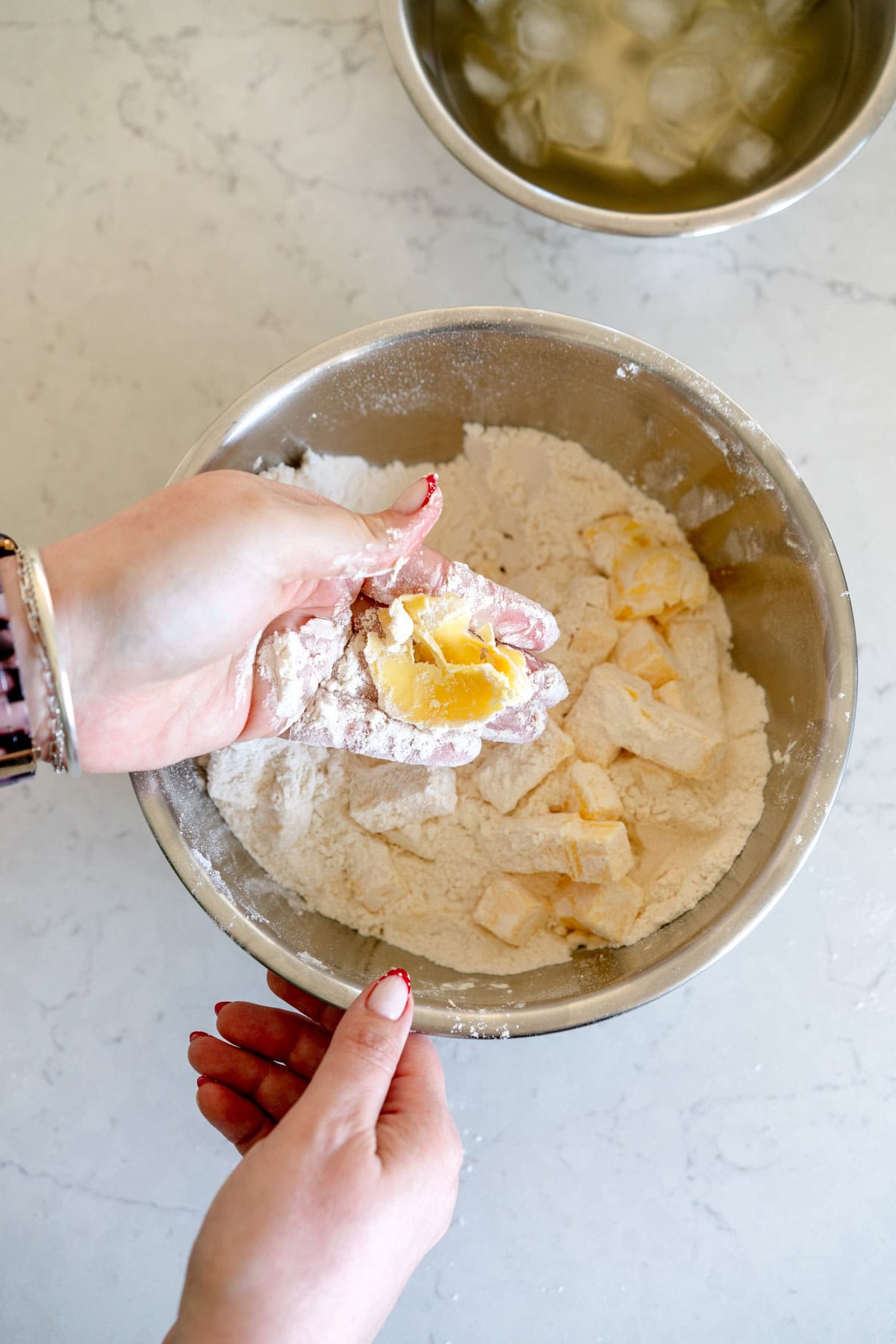
Step 4: Add in the liquid
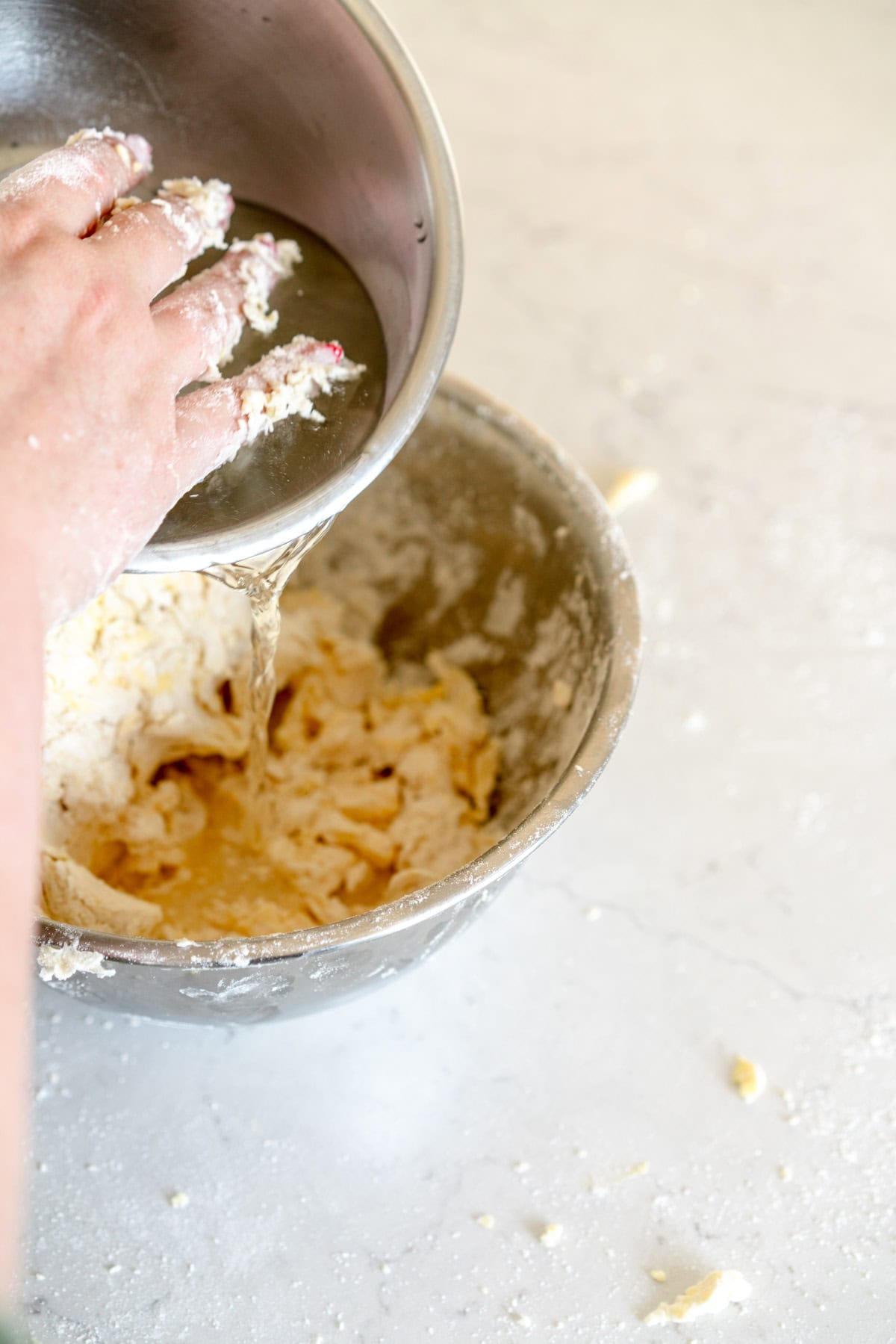
Now you are going to add in the water / apple cider mixture. I like to start with 120g of liquid (do not add the ice). Pour it into the bowl and then do a tossing motion with your hands to incorporate the water. See how the pie crust is feeling and if it still needs more liquid (mine almost always does), add more water in. If there are any particularly dry patches you can hold the more hydrated pie crust to the side and add the water directly to the dry patches.
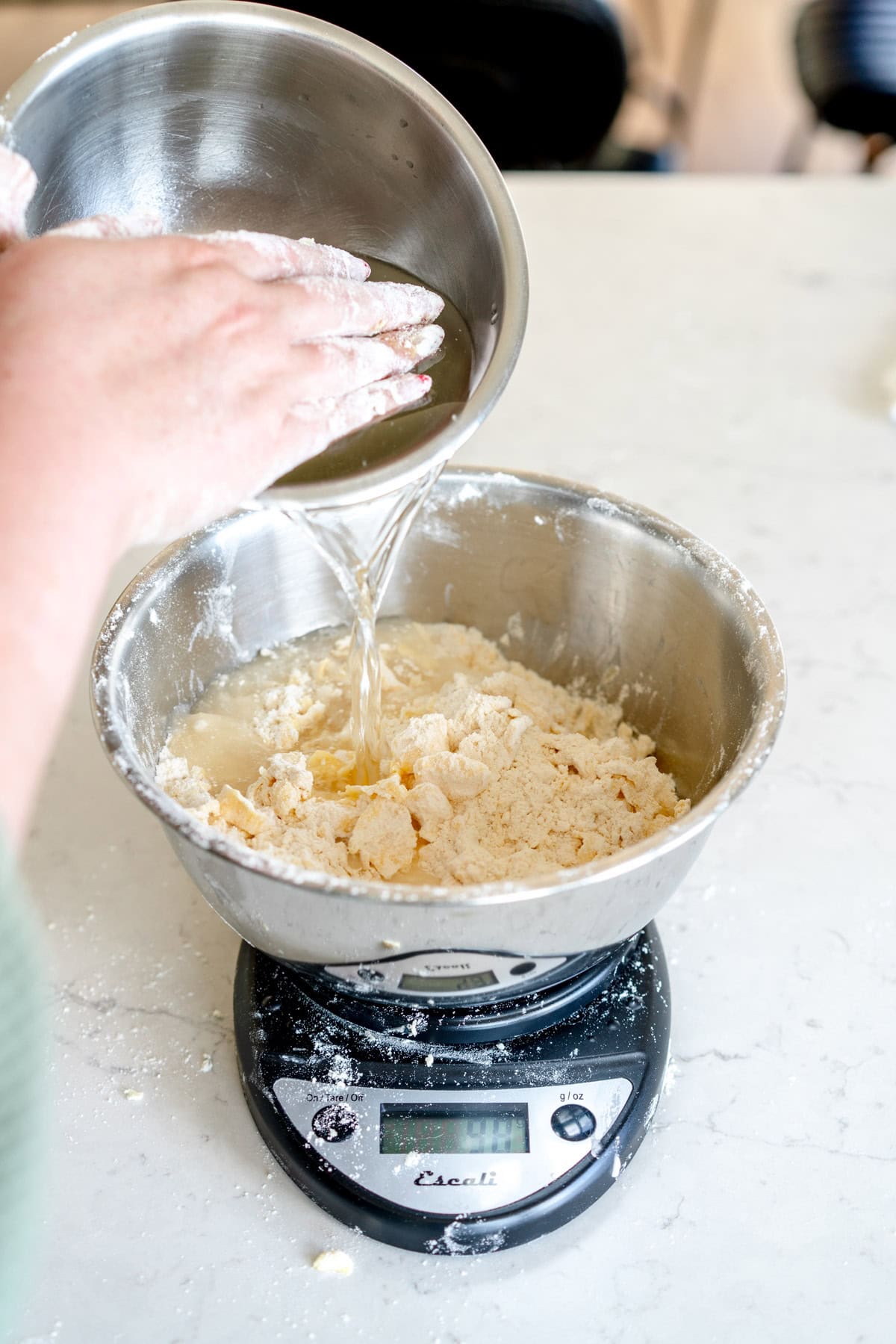
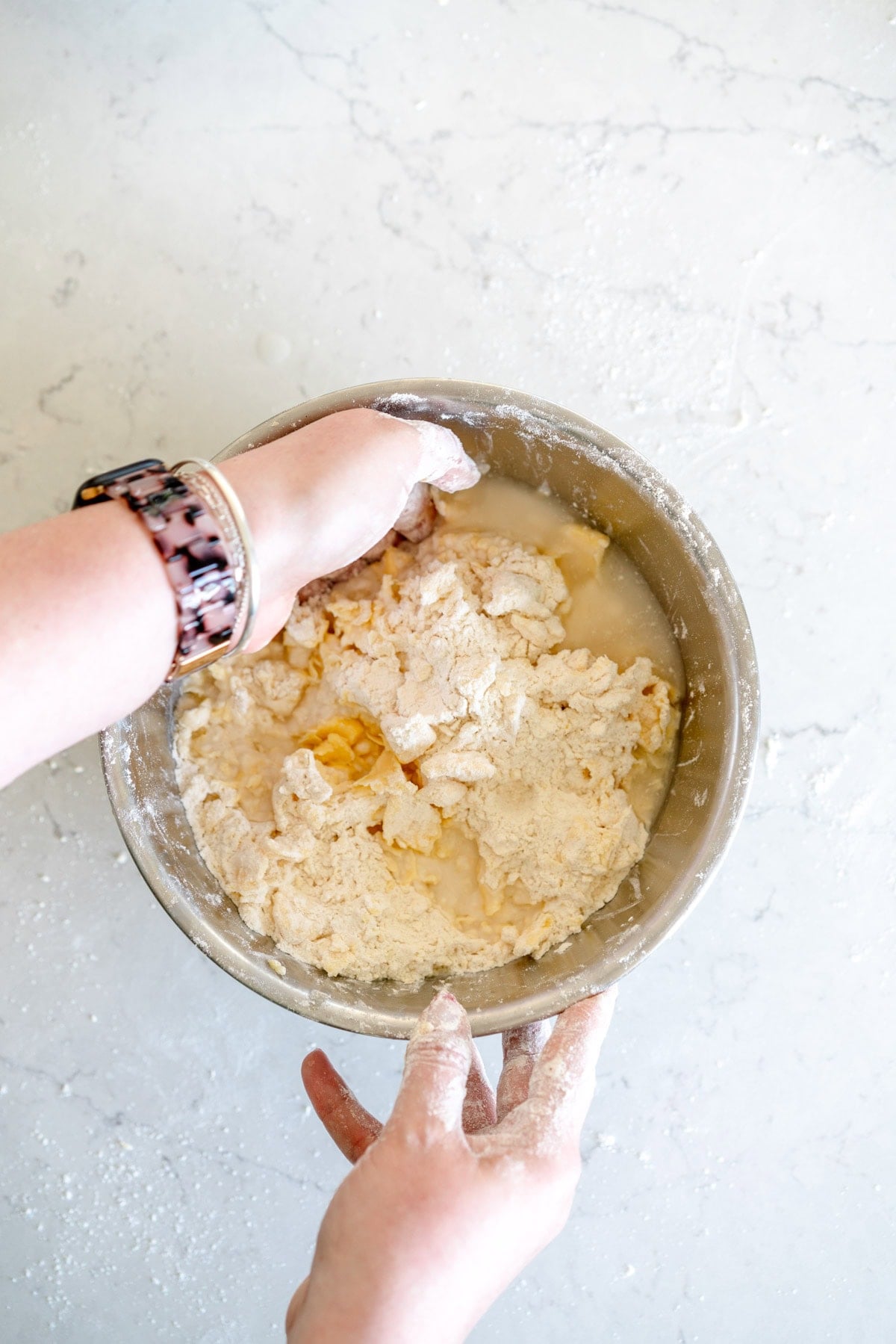
Keep tossing the mix with your hands, squeezing gently to bring the crust together. At no point do you want to knead the dough too much, as you do not want to develop gluten which can make your pie crust tough. Squeezing and pressing together is ok but you don’t want to knead it like you do bread.
You are looking for a dough that holds together well, but is not too wet. Remember it is going to rest in the fridge where the flour will hydrate. You can see in the images that the dough is not completely wet, but holds together well.
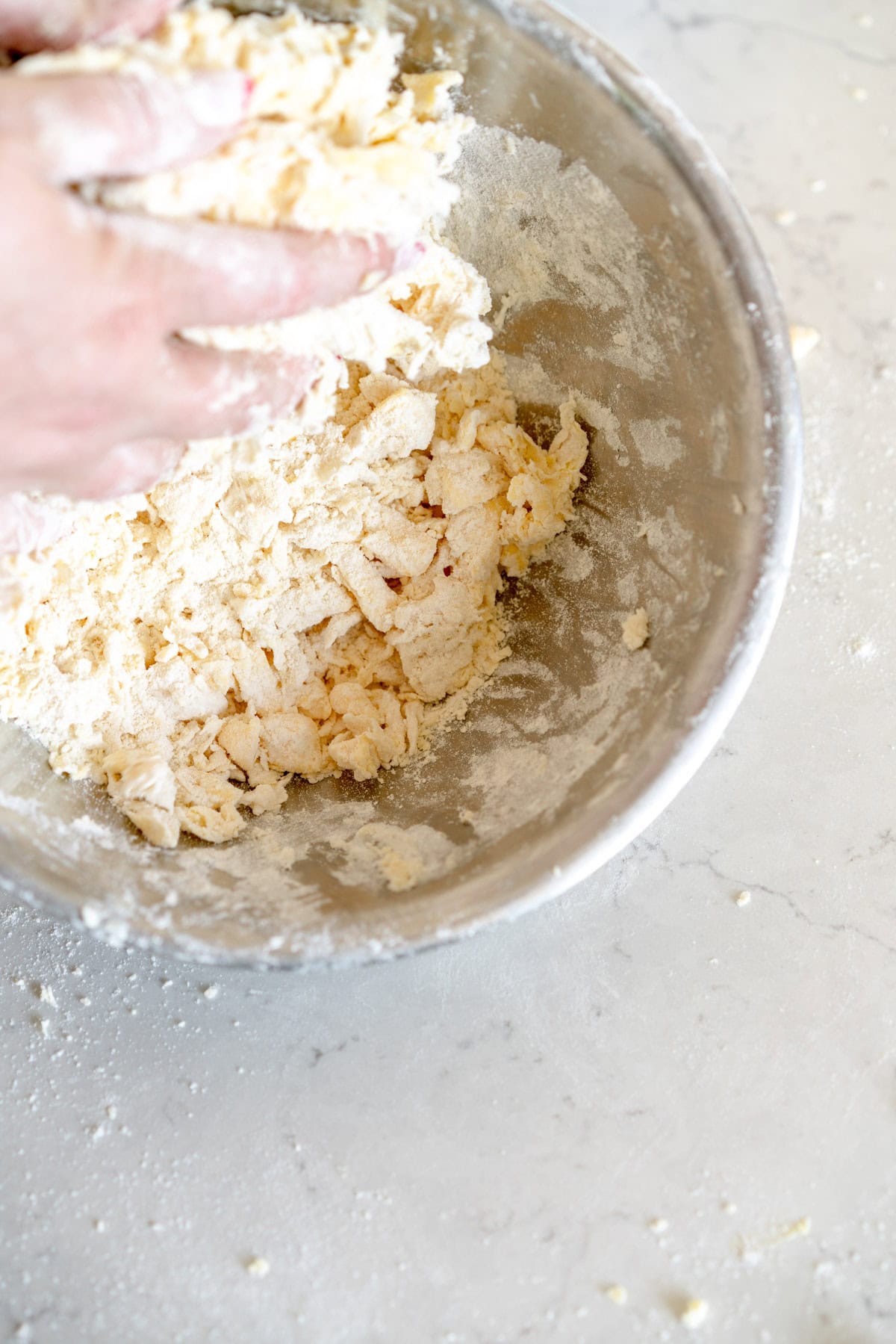
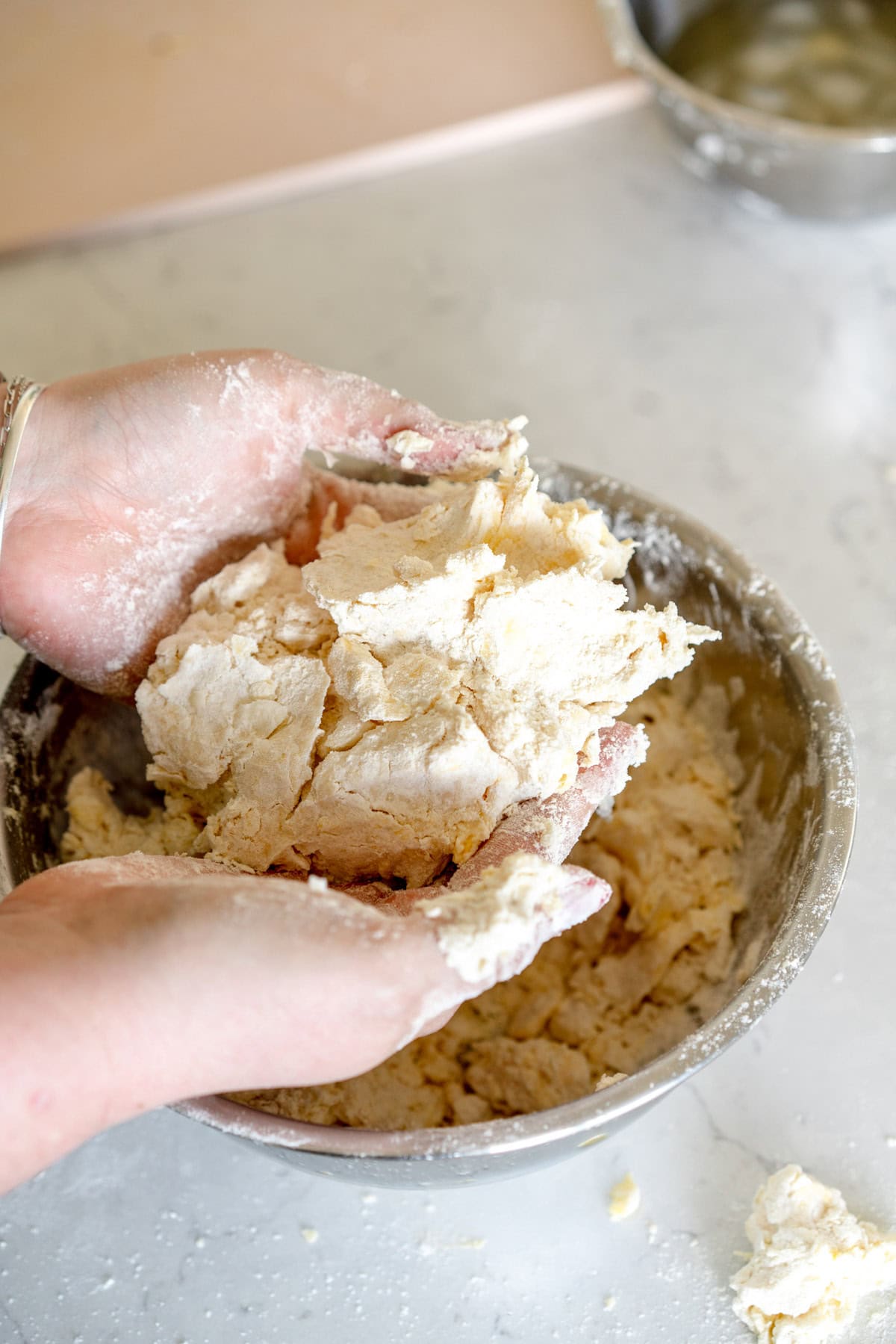
Step 5: Bring the dough together
Turn the dough out onto a work surface (no need to flour), and gently press it together with your hands. I like to shape mine into a flat rectangle at this stage as it makes rolling out the dough for lamination a little easier. Wrap the dough in plastic wrap and rest in the fridge for an hour before doing the laminations. This gives the dough some time to relax and for the flour in the recipe to hydrate.
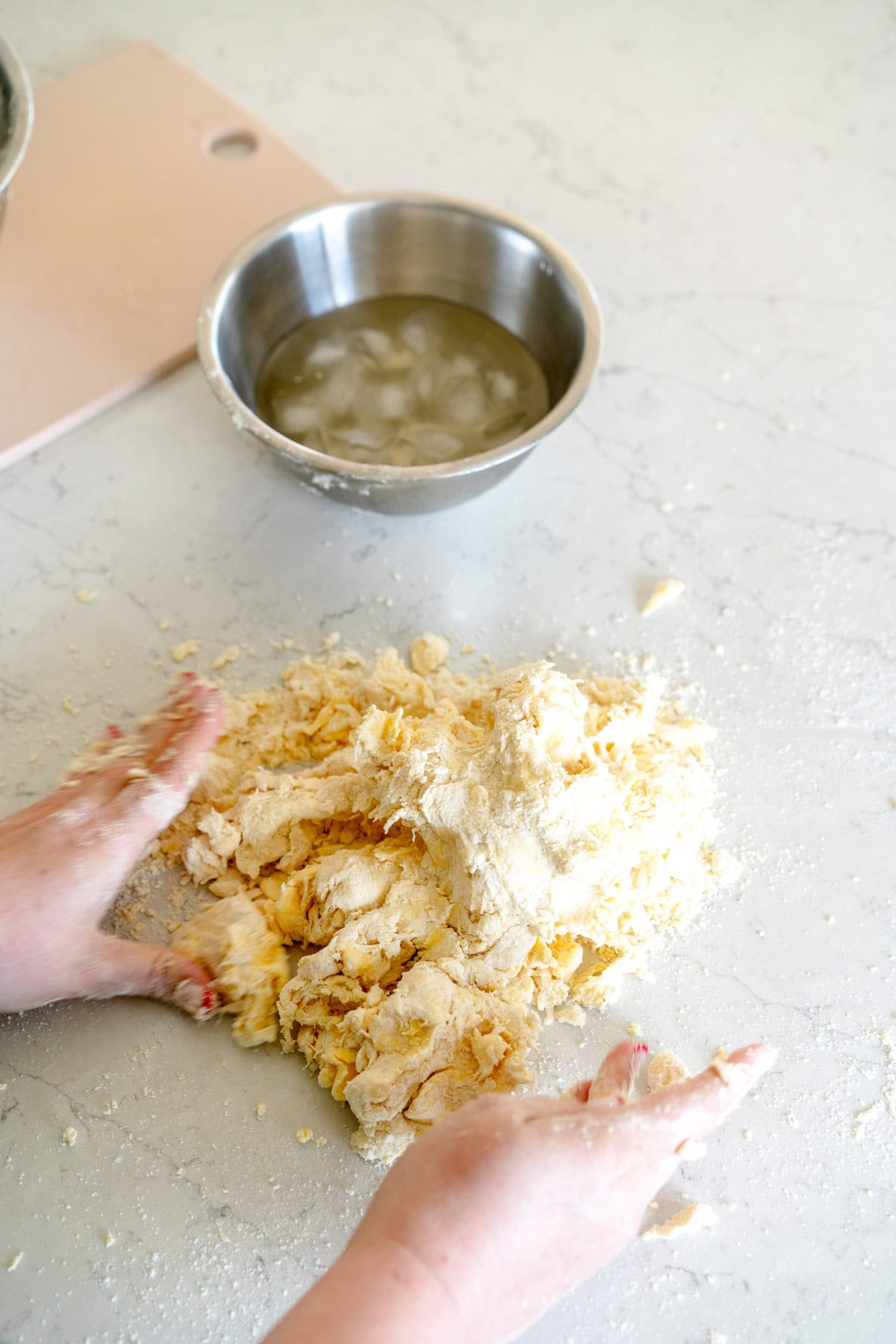
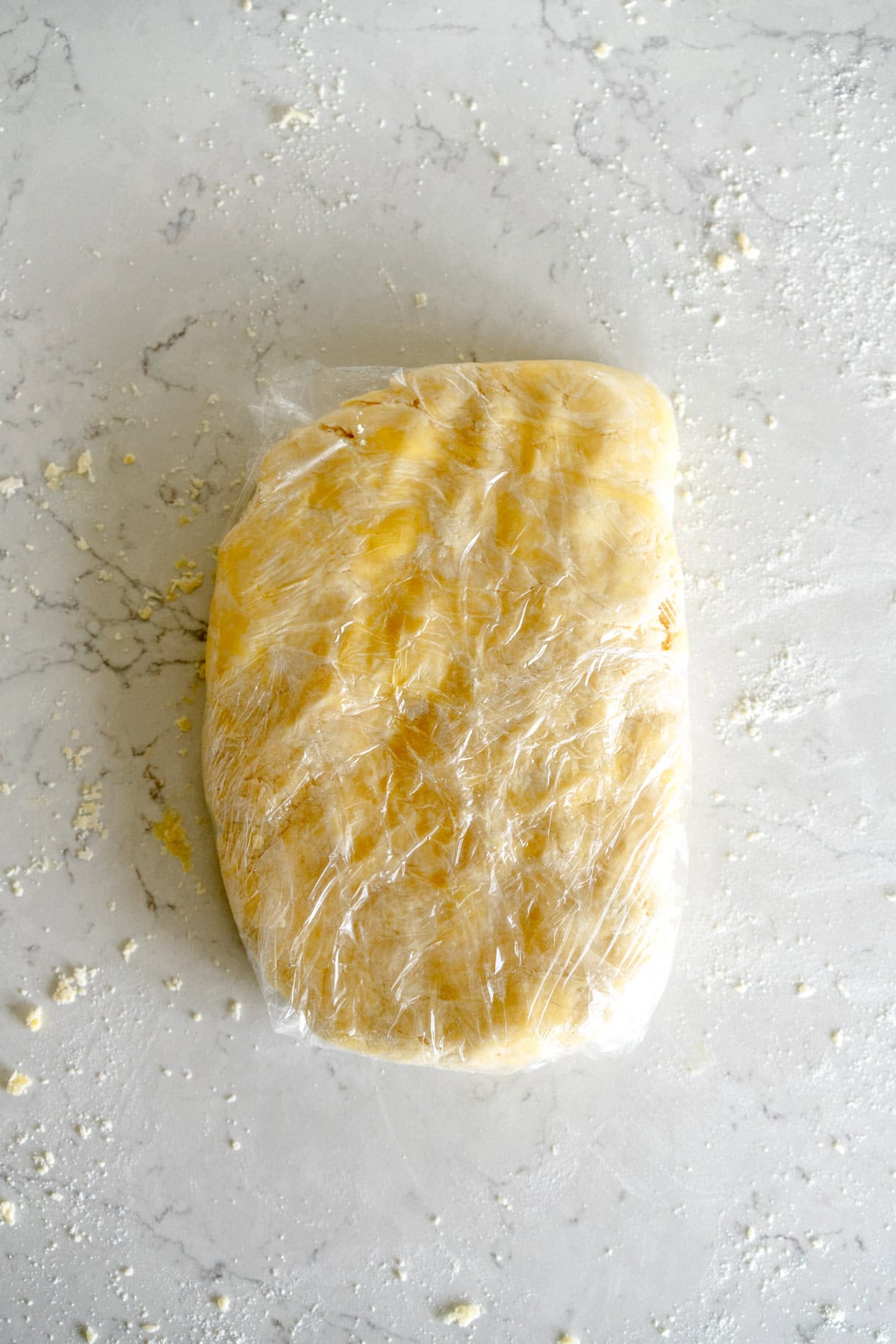
Step 6: Laminate the pie crust
Now you are going to perform three sets of laminations (it’s just a fancy name for folding, don’t let it intimidate you!), essentially rolling out the dough into a rectangle, folding it up, then doing it two more times. I like to use a lightly floured surface, which especially helps if your pie dough is a little over hydrated or has some sticky spots.
Here is how you perform each fold:
1. Roll the dough out into a rough rectangle shape (it doesn’t have to be perfect). I aim for about 35x25cm (about 14x10 inches).
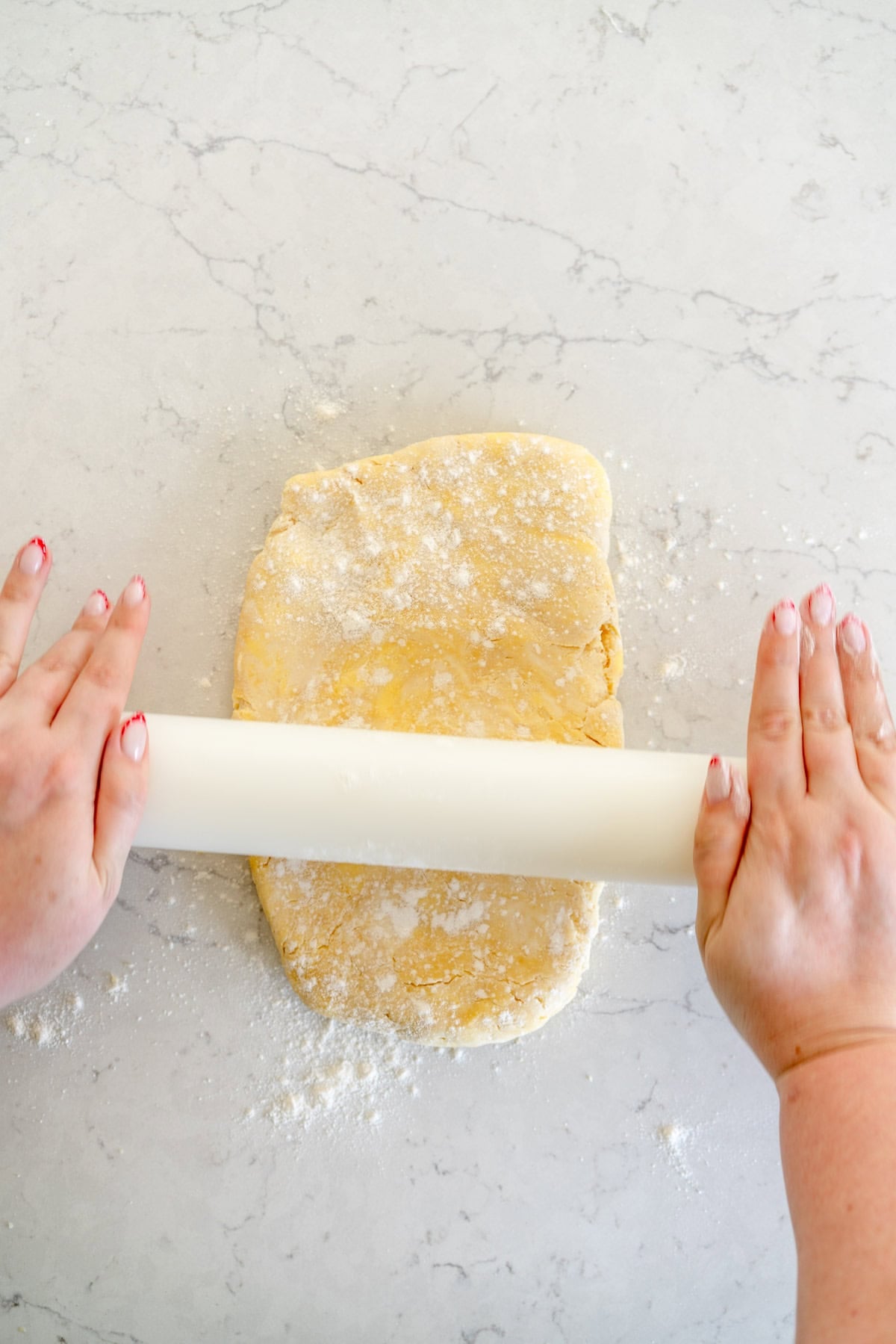
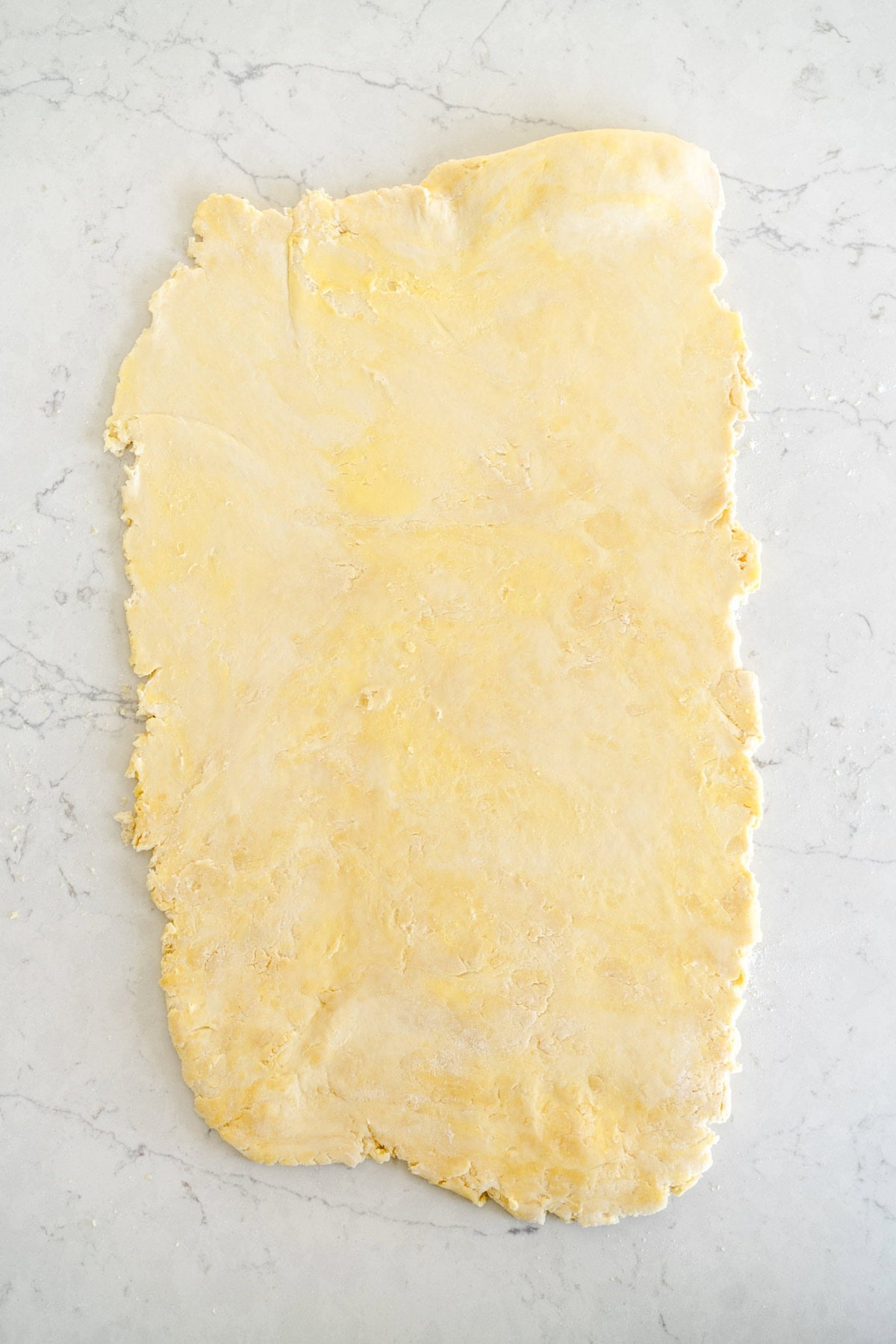
2. Brush off any excess flour. Fold the bottom third of the pie crust up, then fold the top third down over it - this is called a ‘letter fold’.
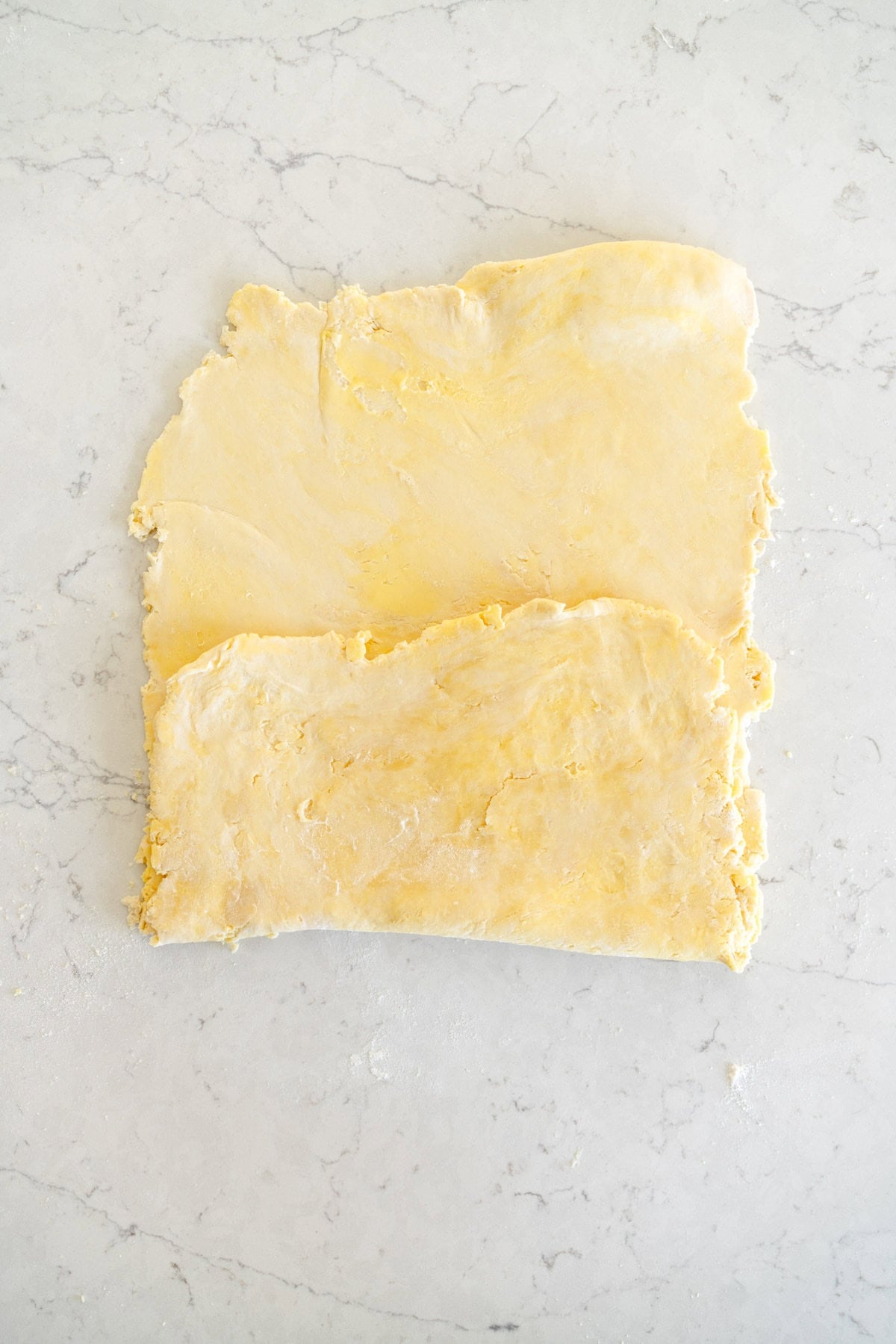
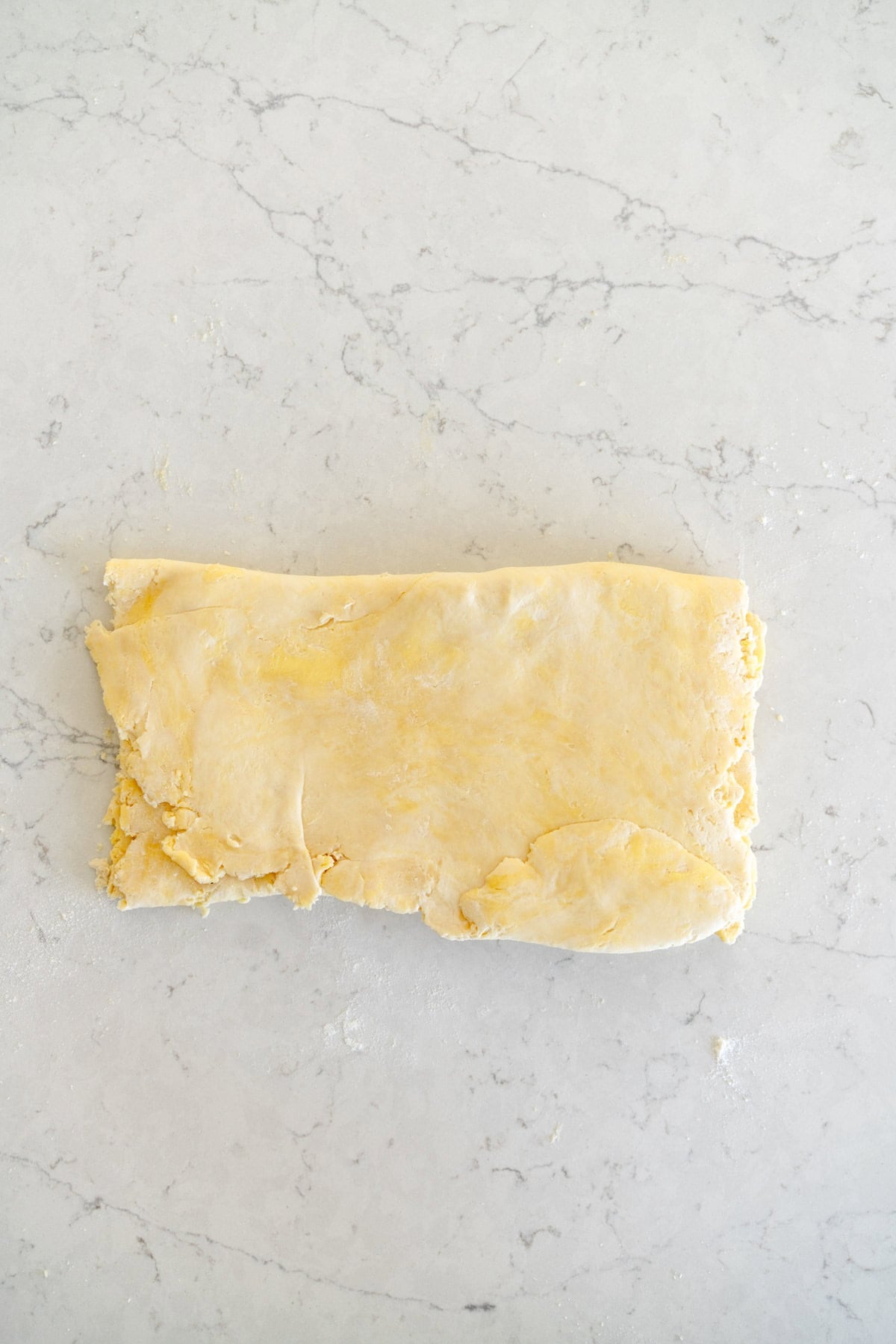
3. Turn the dough 90° so that the short side is facing you.
Repeat this process two more times until you have done three folds of the dough. If at any point it feels like the dough is warming up too much, you can wrap it and pop it back in the fridge for 10-15 minutes but I find that as long as I start working with the dough as soon as it is out of the fridge, I can do the folds all in one go.
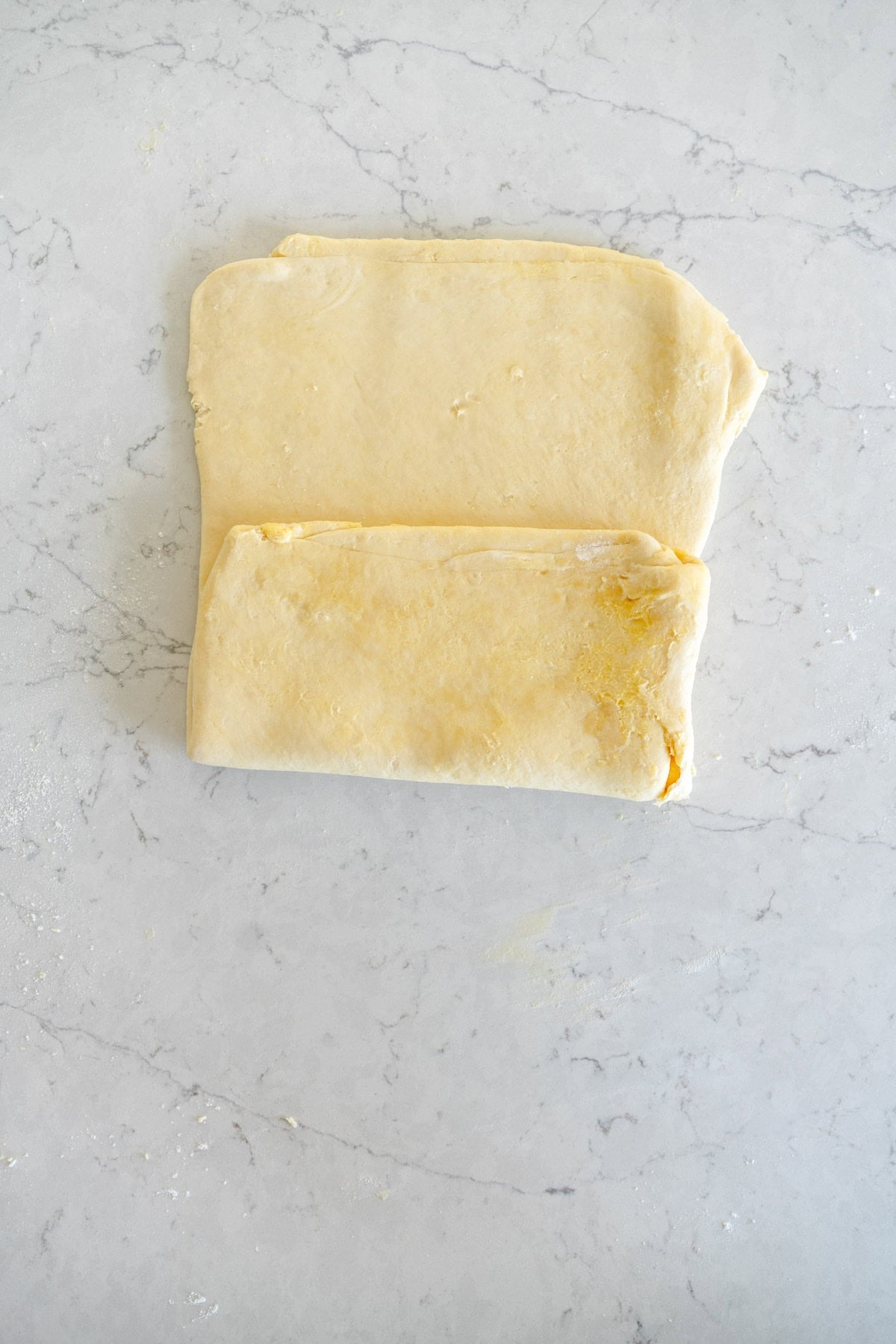
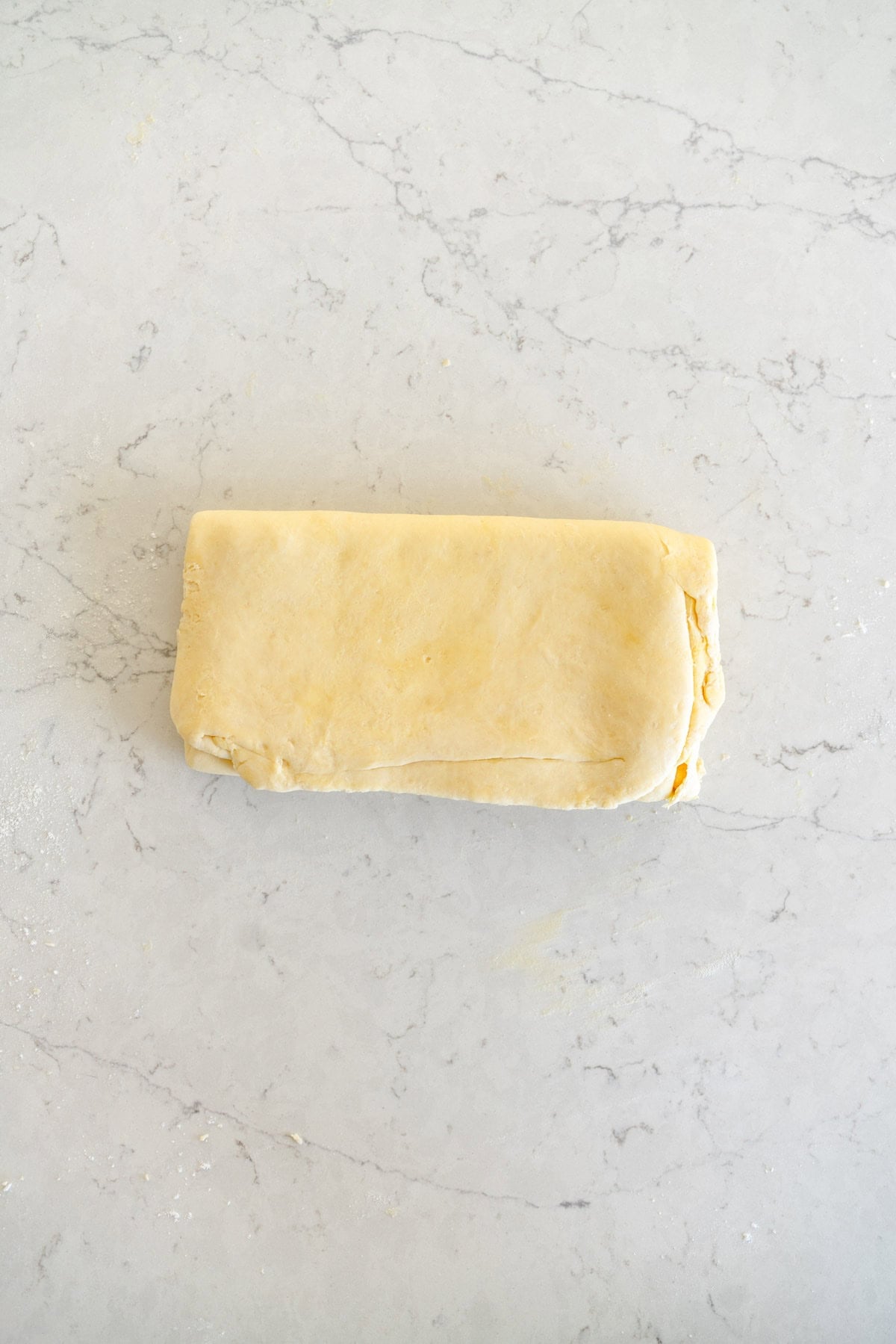
Step 7: Divide up the dough
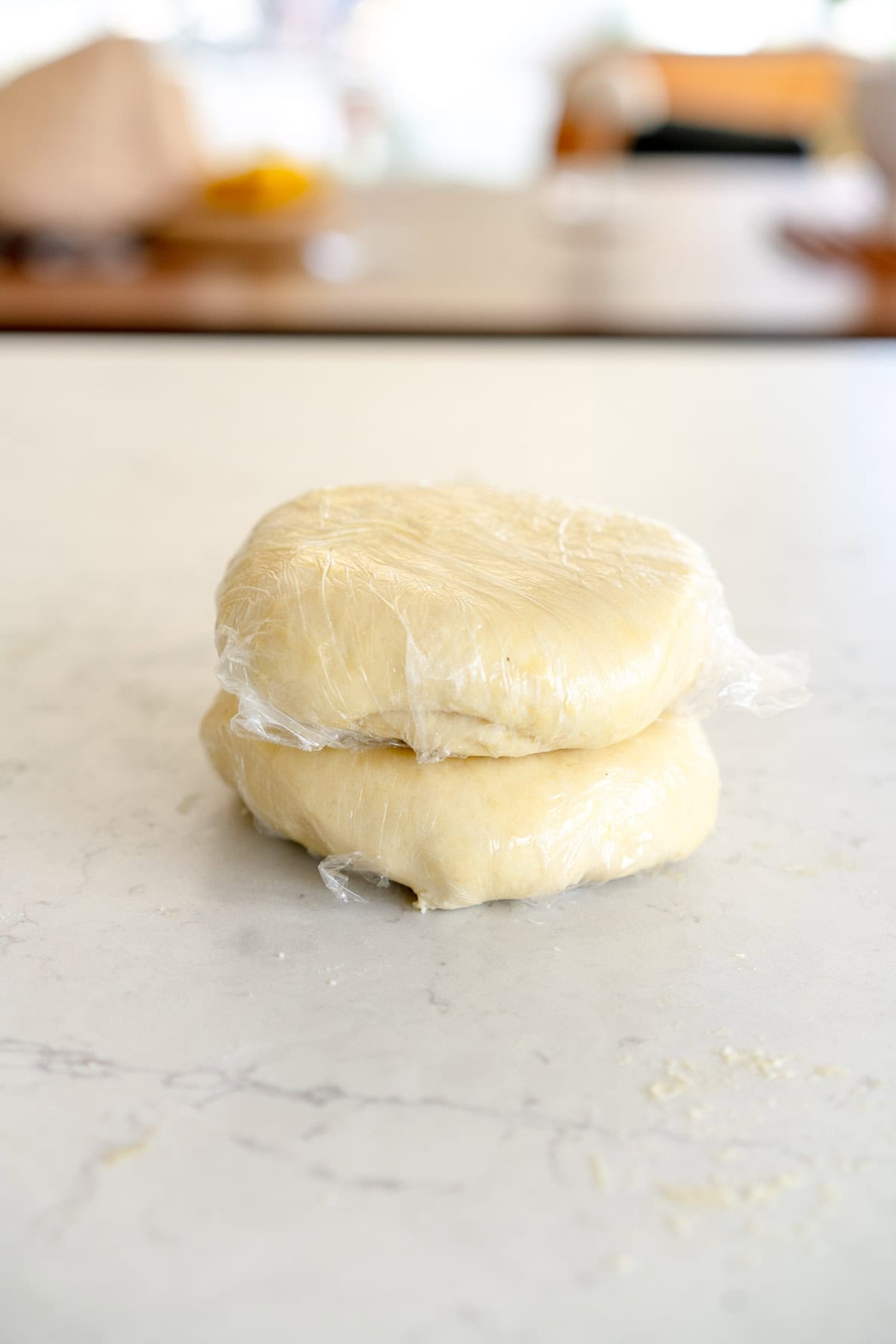
My Pie Crust recipe makes enough for two single crusts or one double crust pie, so once you have done the final fold you can divide the dough in two and shape each into a disc. To do this, I turn it over and fold the edges in, then turn it back over and flatten with my hand slightly to make a disc.
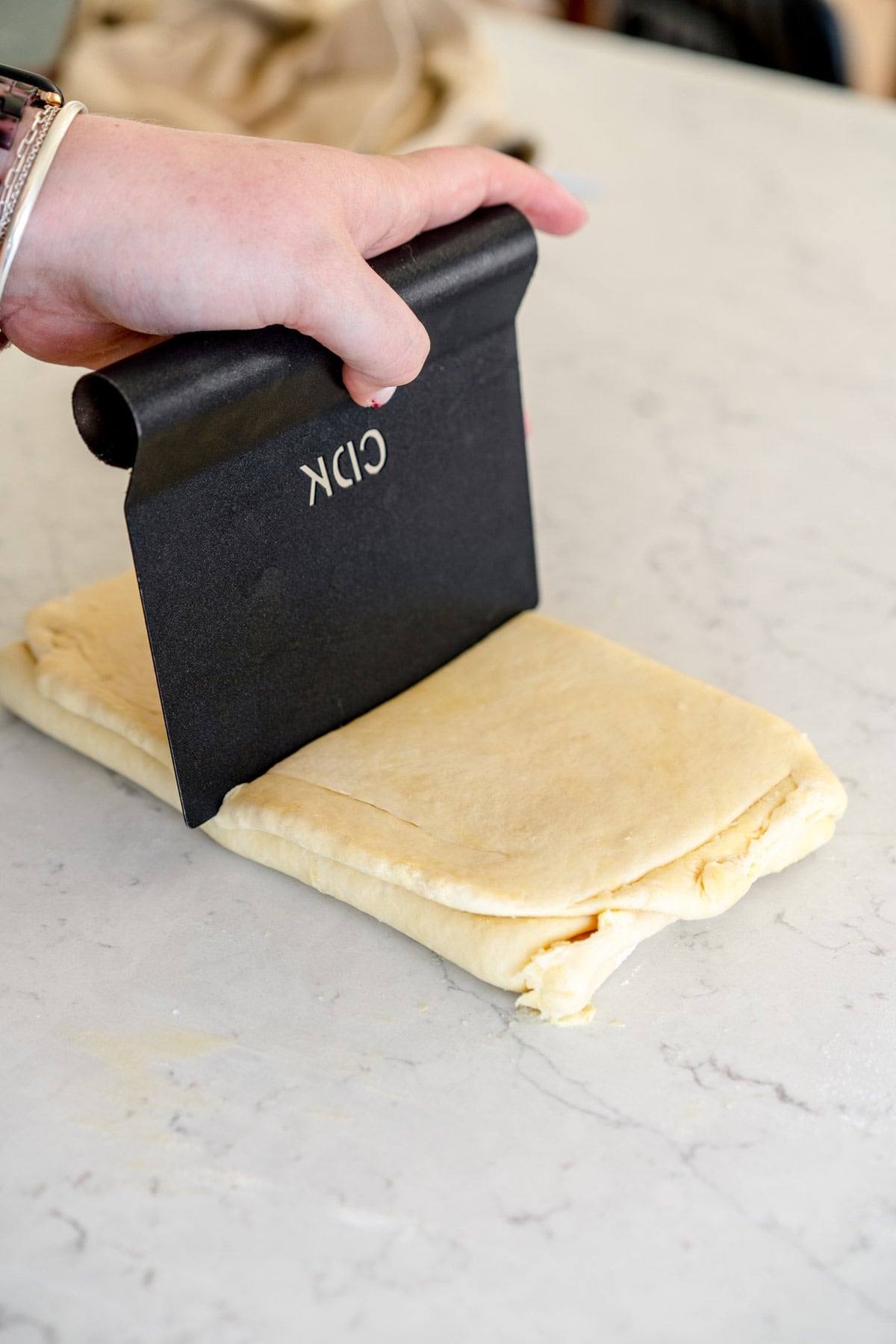
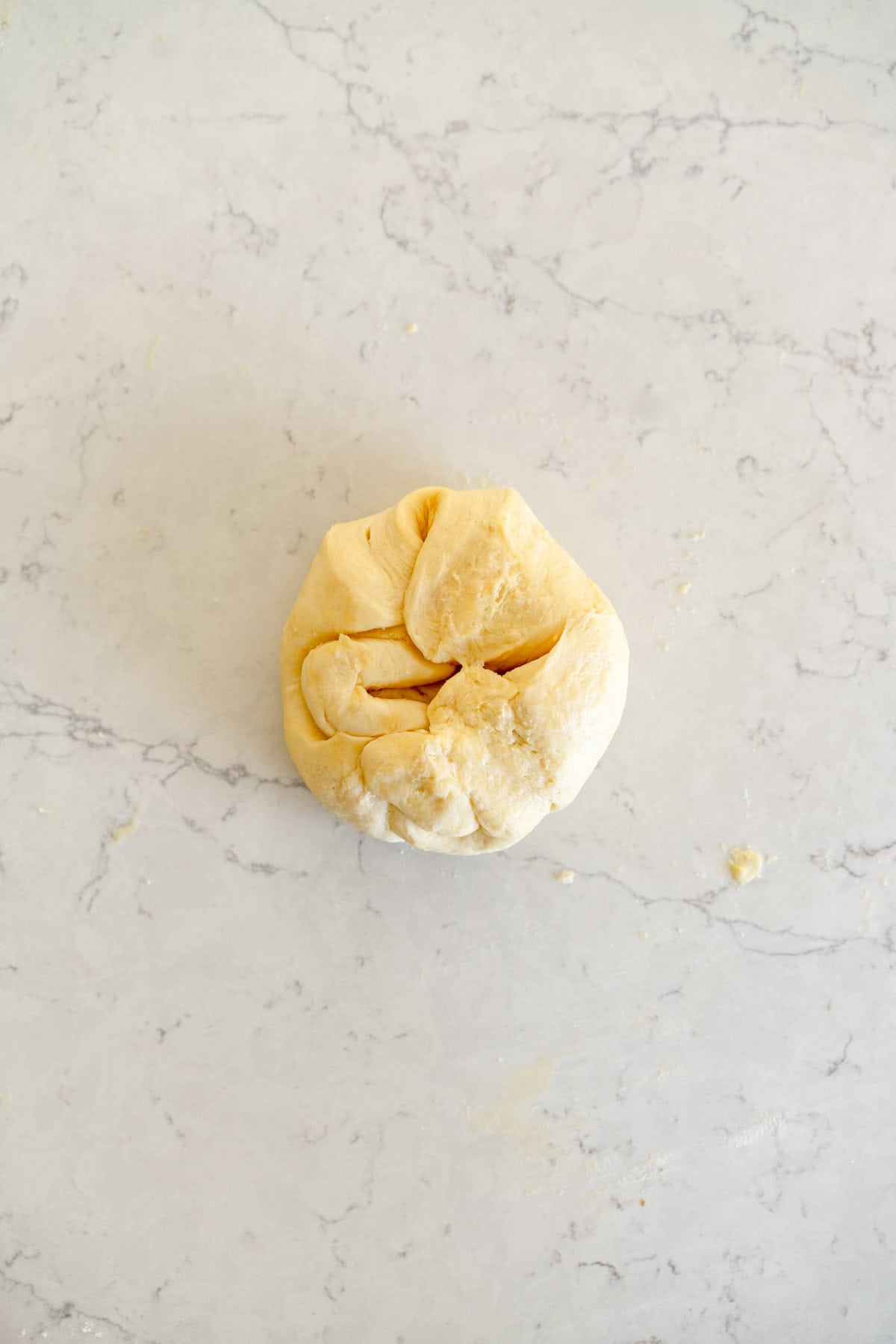
Step 8: Chill the dough
This is a super important step. You must chill your dough for a minimum of two hours, but I prefer to do overnight if I can. This lets the gluten fully relax, as well as making sure that the dough is fully hydrated. If you are making dough to freeze, I like to chill it first then transfer to the freezer.
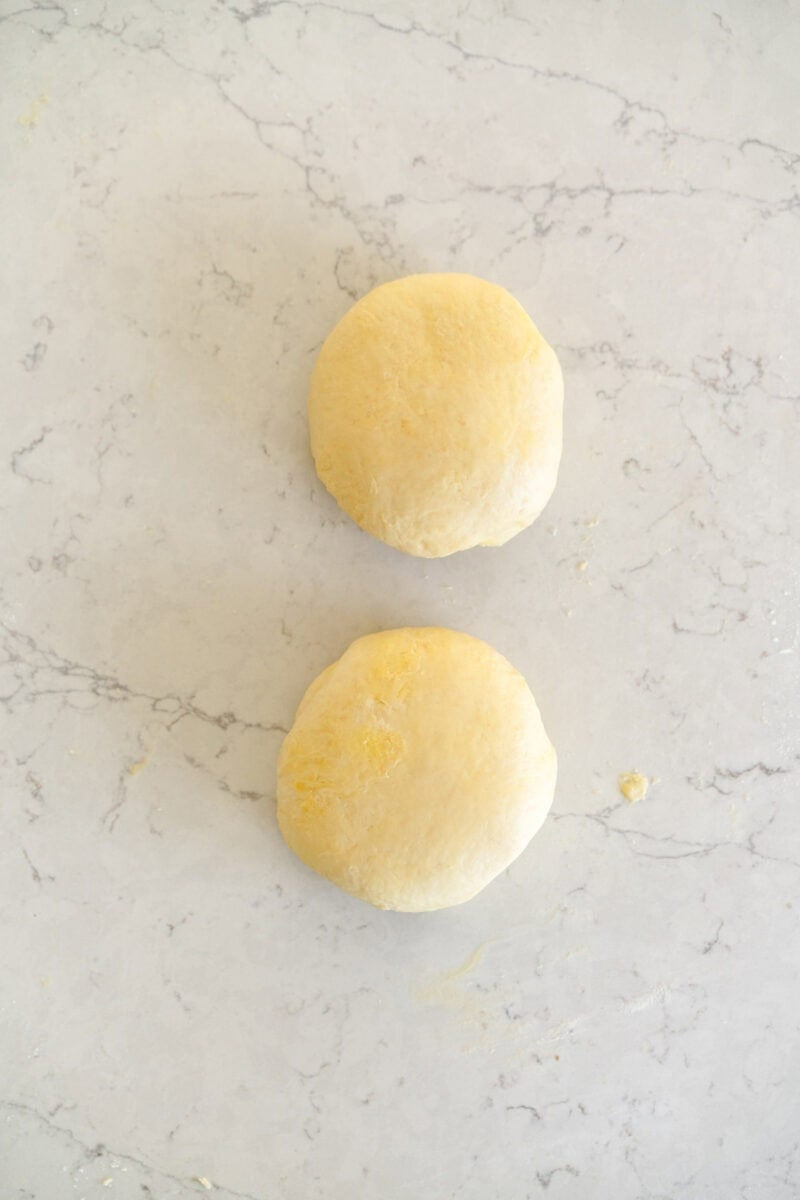
How long does pie crust last in the refrigerator?
I like to make my homemade pie dough ahead of time - ideally the night before, but this can be done up to three days ahead of time if you are storing your pie crust in the fridge. Make sure that it is well wrapped, and use it straight from the fridge to keep everything nice and cold and to ensure that your pie crust is easy to work with.
Sometimes if you have left pie crust in the fridge for too long it will start to oxidise and turn grey - this is how to tell if pie crust is off. If you are unsure when you are going to use it, your best bet is to throw it in the freezer and bring out to thaw when needed.
How to freeze pie crust
The great thing about making homemade pie crust is that it is easy to make a whole bunch at once, and then freeze it until you are ready to use it. Pie crust will keep in the freezer for up to 3 months. I like to wrap it well in plastic wrap once it has been shaped into a disk, then add a layer of aluminum foil on the outside just to help with freezer smell.
To thaw pie crust, remove from the freezer and place into the fridge overnight until it has thawed. It is now ready to use the exact same way you would use a fresh pie crust from the fridge.
Can I freeze the pie crust in the pan?
I don't recommend doing this - things get weird and dried out. You are much better to just freeze the dough as discs, well wrapped, then proceed as usual.
How to scale a pie dough recipe
If I am making multiple batches of pie crust, I often do it all in one go. However there is a limit when scaling the recipe. You don't want to do too much at one time or you run the risk of over working your pie dough. The recipe below makes enough for a basic double crust pie, or two single crust pies. I divide the dough and shape it into a disc and store like that. I like to scale the recipe around how many discs of dough it will yield.
The most I recommend scaling this pie crust recipe by is a double batch, which will yield 4 single pie crusts. If you do any more, I would work in batches. Usually I do one batch of this pie crust recipe at a time if I can. Then I make multiples of it depending on how much I need.
This recipe makes enough pie crust for two single crust pies, or a basic double crust pie with a basic lattice. If you are making a pie where you want a more detailed top crust, I suggest making a 1.5 batch of this recipe to ensure you have enough. Any leftover pie crust can be wrapped in plastic and kept in the fridge or freezer for another time.

I screwed up my pie crust so you don't have to
Let's trouble shoot together.
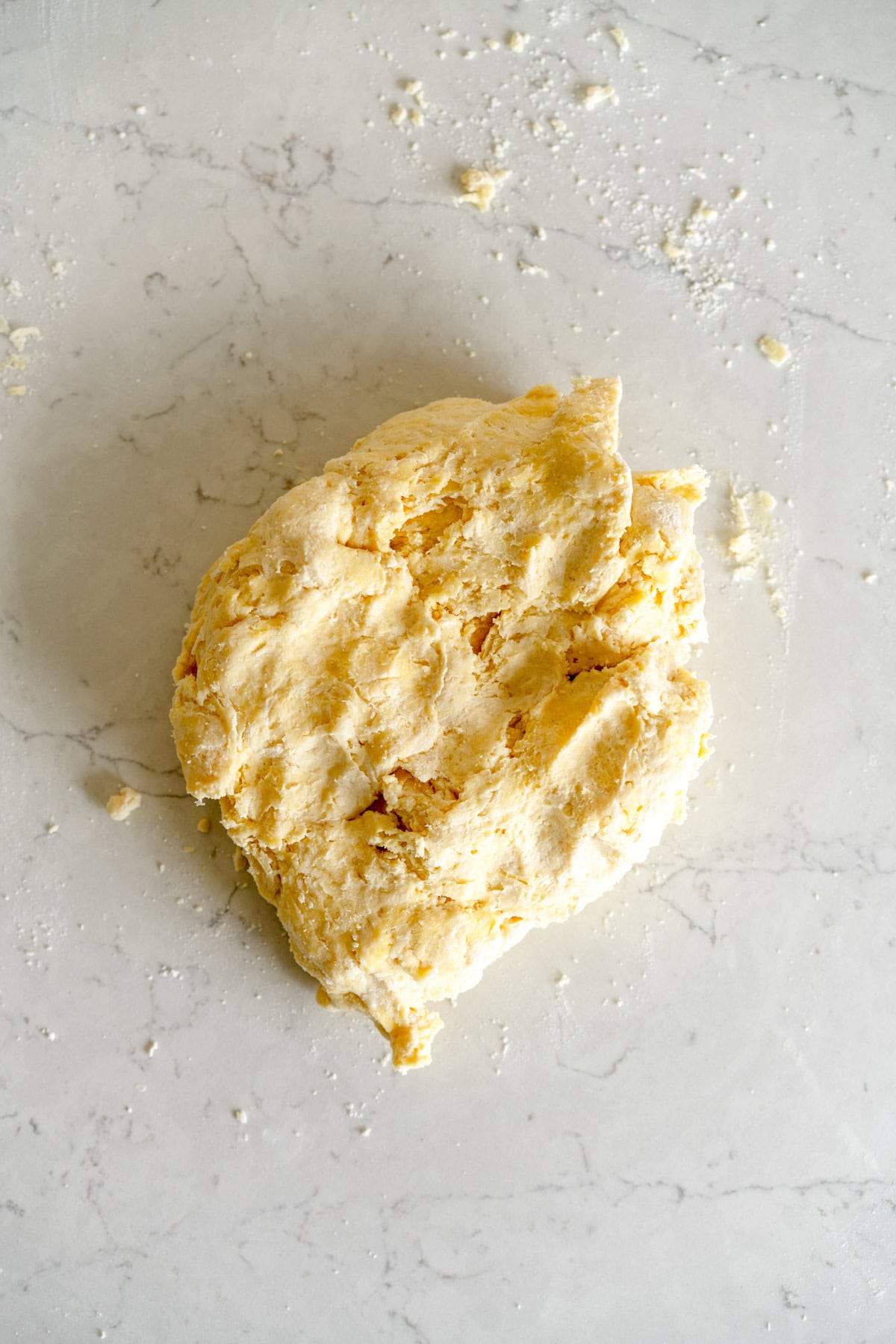
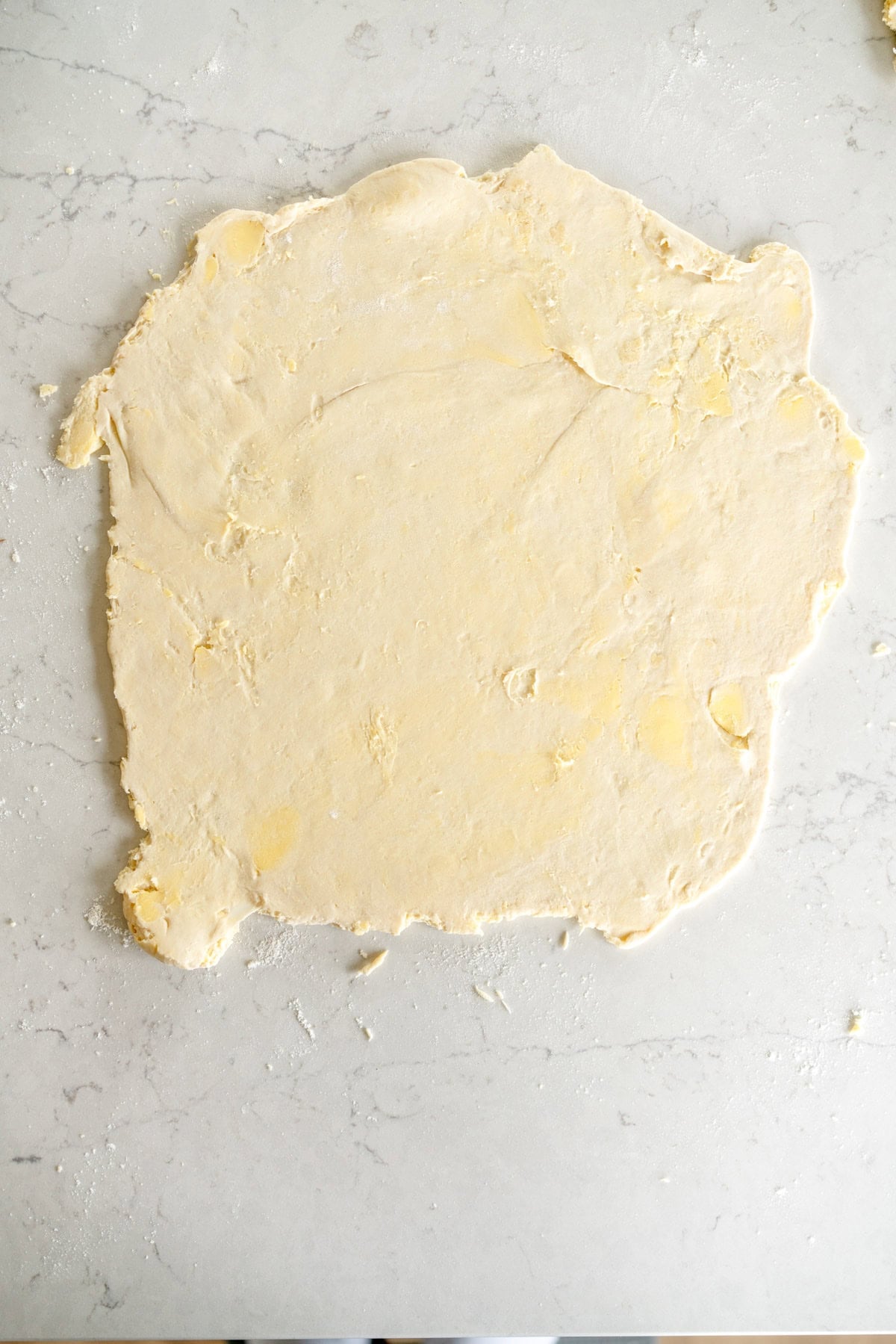
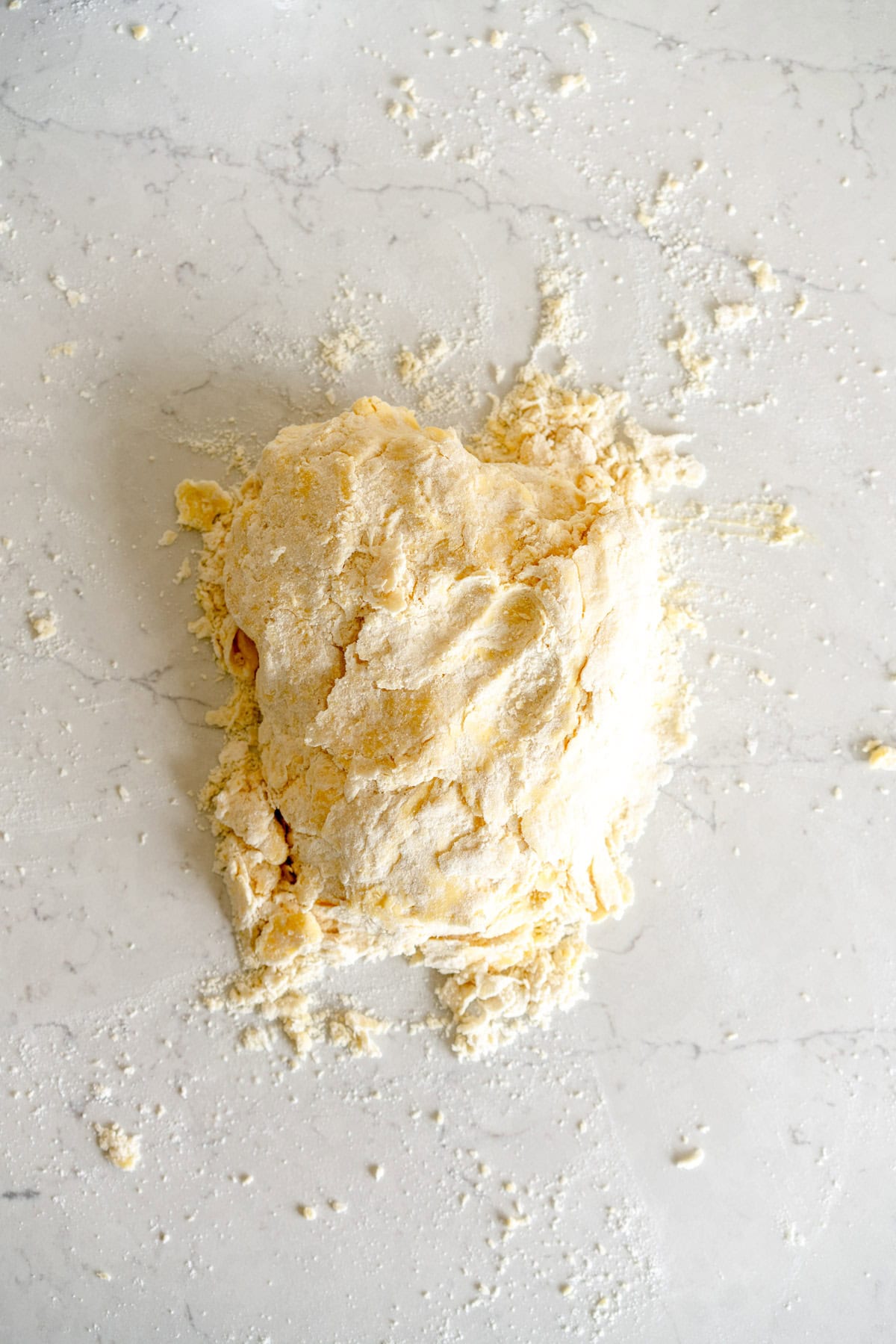
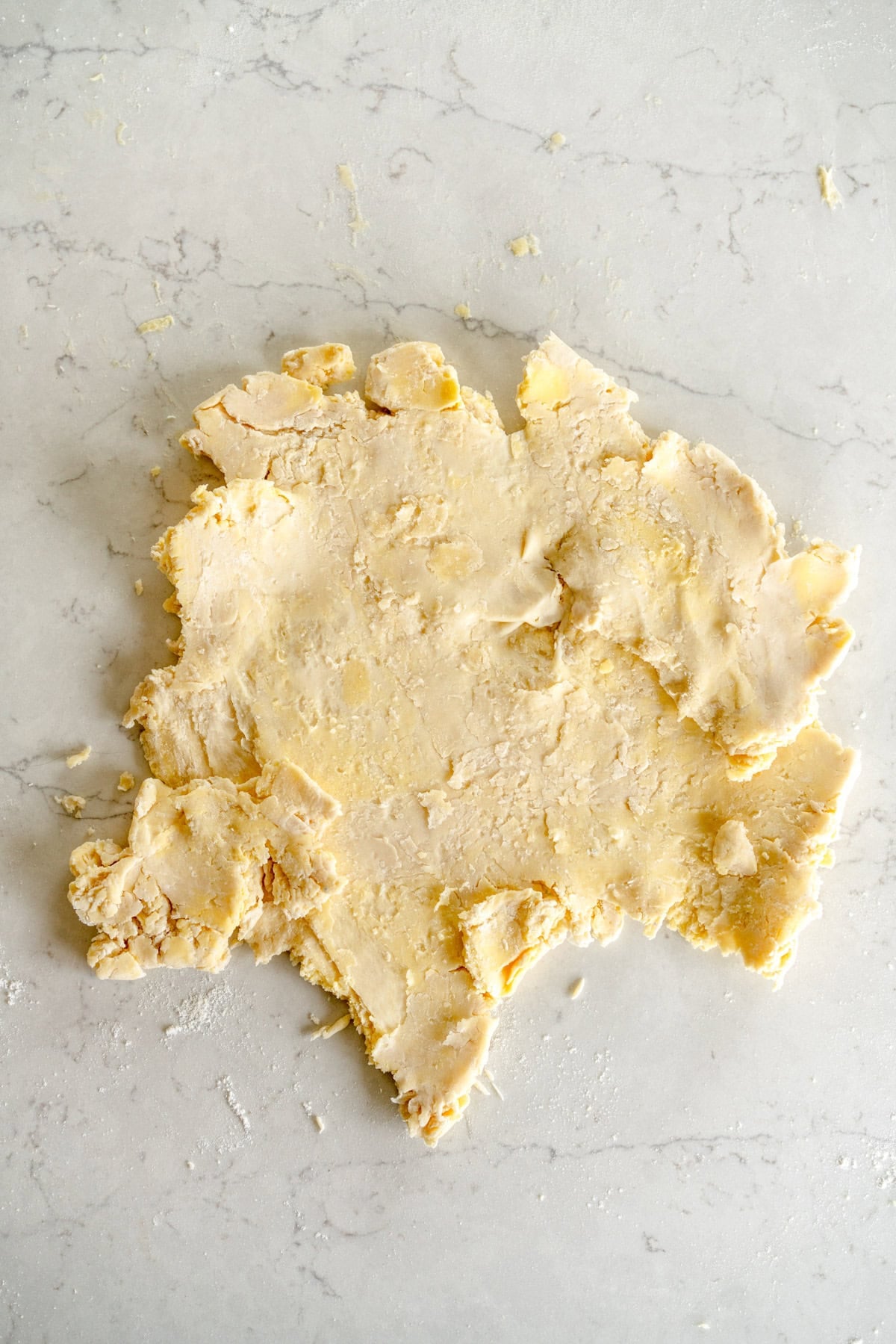
While this pie crust guide should set you up for success, there are a few things that can go wrong when you are making pie crust. Here are the most common ones. Firstly here is an image showing pie crust that is too wet, too dry, and just right.
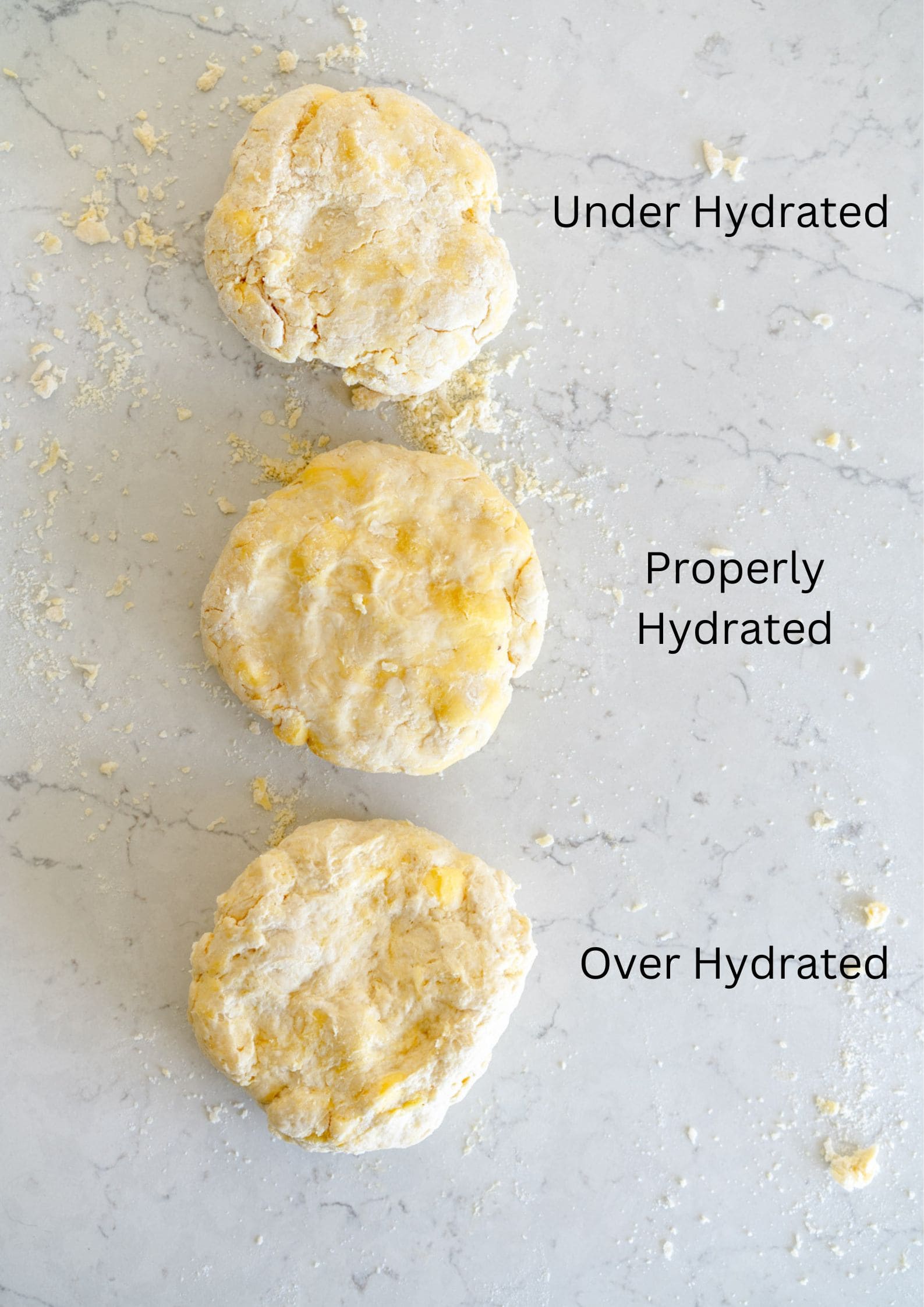
Pie Crust is over hydrated:
The dough will be sticky and hard to roll out. Remember that when the dough is resting in the fridge the flour will hydrate, so you don't want it to be too wet just after mixing. Start with the amount of water suggested in the recipe as a starting point and then add more from there carefully.
How to fix it:
You can fix over hydrated pie crust by dusting lightly with flour when you are doing the lamination steps. I find it easier to fix an over hydrated pie crust than an under hydrated one!
Pie Crust is Under Hydrated:
You know your pie crust is under hydrated when you have big dry chunks and it is hard to bring the dough together. Pie Crust that is under hydrated will be really hard to roll out, and will not have relaxed enough to make an easy to work with pie dough. Add a little more water when you are mixing - if needed, sprinkle some water on the dry parts at the bottom of the bowl and incorporate them in.
How to fix it:
Unfortunately it is not as easy to fix an under hydrated pie crust. You can try flicking a little water on it during the lamination steps, but often it will be hard to work with and really hard to roll out as the dough has not relaxed enough so will 'snap back' on you a lot.
Large Butter Chunks in Pie Crust
If you have large butter chunks in your dough, it is not going to roll out evenly and will seem like that it is lumpy.
How to fix it:
Make sure that when you are incorporating the butter, it gets mixed in enough so that all the pieces of butter have been shingled. Large pieces of butter mean they won't full incorporate into the dough, and may leak out in the oven or make lattice work difficult.
Pie Crust is leaking butter in the oven:
This often happens if the butter chunks were too big in your pie crust. When you do the lamination step, it should leave you with homogenous dough. Sometimes you can see leakage of butter from the crust around the edge of your pie dish. A little leakage is fine, but if you find that you are getting pools of butter, it is likely that you have not incorporated the butter well enough.
How to fix it:
Make sure that you do your laminations / folds in your pie crust. This makes it much more homogenous and gets rid of the large butter lumps, flattening them and making the crust much easier to work with and much less likely to leak.
Pie Dough is cracking when you go to roll it out:
This could be because it is too cool, or your dough is under hydrated. I like to press on the dough with my rolling pin a few times to help even it out before I start to roll. Forming the dough into a disc before it goes into the fridge and tucking the edges under means you get a nice clean edge on it too.

Commonly asked questions
- What tools and equipment do you use?
You can see a full list of all the tools I use here - Is Pie Crust the same thing as pie dough?
Yes! I use the words interchangeably but as far as I am aware, they are the same thing - Can you make pie crust gluten free?
Not with this recipe. But there are a bunch of gluten free specific pie crust recipes out there, so I would try one of those rather than trying to adapt this.


❤️ Made this recipe and love it? ❤️
I would LOVE for you to leave me a review and star rating below to let me know how you liked it! Also, please make sure to tag me on Instagram!
Answers to your baking questions
Over the years, many of you have asked me questions about:
- baking in grams
- adjusting oven temperatures
- what kind of salt to use
- and many more!
I've curated and answered them all for your easy reference in this frequently asked questions post!

All Butter Pie Crust: A Beginner's Guide
- Prep Time: 30 minutes
- Total Time: 2 hours
- Yield: 2 Pie Crusts 1x
- Category: Pie
- Method: Baking
- Cuisine: American
Description
Think you can't bake the most buttery, flaky pie crust home? Think again, because yes you can! Learn how to make the most perfectly flaky and tender all-butter pie crust in your own kitchen using a series of simple, easy folds, a technique called lamination. It's my secret for an ultra-flaky pie crust that's easy to work with, doesn't crumble, or leak. Made without vegetable shortening, my homemade pie crust has been tested, and perfected over many, many months. It's foolproof!
Ingredients
- 375g all-purpose flour
- Pinch of Salt
- 225g cold unsalted butter, cut into cubes
- 240g cold water
- 1 cup ice
- 60g Apple cider vinegar
Instructions
- Place flour and salt into a large bowl. Cut butter into chunks, and add to the flour. Toss lightly to coat.
- Incorporate the butter. Working quickly, using a pastry blender or your thumb and fingers, cut the butter into the flour mixture until there are only large pea-sized chunks left. You want a few lumps of butter remaining to keep the pastry nice and tender.
- Add the water and mix the pie dough. Combine ice, water and cider vinegar in a bowl. Sprinkle a few tablespoons of the ice water into the flour and butter mixture, and using a stiff spatula or your hands, mix in well. Continue adding water a tablespoon at a time ( I usually start with about 120g liquid, mix that in, then go from there and add additional liquid as needed) until you have a dough that holds together well, but is not too wet.
- Shape the pie dough. Squeeze together with your fingertips to make a homogenous dough. Shape into a rectangle, Rest in the fridge for one hour.
- Laminate the pie dough. Roll out the dough on a floured surface into a rectangle, fold it in thirds like a letter, then roll again and repeat the folding. Repeat this process one more time. Divide the dough into two pieces, and shape each into a disc by folding the edges under. Rewrap tightly in plastic, and rest for at least two hours, or preferably overnight, before using. Store pie crust in the fridge for up to 3 days, or in the freezer for up to 3 months.
Notes
Makes enough pie crust for one double crust pie, or two single crust pies. If you double the recipe, you may not need to double the quantity of water and vinegar - see how much you have left first and make up more if needed.
If you are doubling the pie crust recipe, divide into two rectangles before the lamination step and work with each separately to make two crusts each per rectangle of dough.
My recipe used to have 8g (2 tsp) of sugar in it but I have not been using the sugar in the recipe for years. If you would like to keep it in please go ahead - add it in along with the salt.
Comments
stacy says
this is the best pie crust recipe! works perfectly every time 🙂
Tawney says
Hi, this is the first all-butter pie crust recipe that has really worked for me! I followed this recipe in conjunction with Erin’s pie crust instagram reel and my crust came together just like the one in the video. I forgot to refrigerate the crust for 30 min after crimping so it shrank a little during par baking but that’s on me and it was still delicious and flaky. My only other comment about the parbaking process is that after I removed the parchment and pie weights the crust in the bottom of the pan was still very raw. Do you ever pop the crust back in the oven for a few more minutes after removing the weights ? Overall this recipe is a keeper and will now be my go-to!
Erin Clarkson says
Hi hi! The recipes you follow with the par-baking should instruct you to remove the parchment and pop it back in either for a little bit or slightly longer depending on the recipe that you are using (whether it's par-baked or fully blind baked) 🙂
caribou says
thanks for this! the lamination has made a huge difference for me.
Talia says
Hello!
I just tried to make this pie crust and had a few issues when it came to baking it. The taste and flakiness of the crust is absolutely amazing, however when I tried to blind bake it I got a lot of shrinkage. Any helpful tips or ideas of what I may have done wrong? Thank you!
Erin Clarkson says
Hi! Sounds like you've over hydrated your dough, or it wasn't chilled enough! Was it quite sticky when you rolled it out?
Sue says
hi!
I also had a lot of shrinkage in my dough. I tried everything, including adding the barest minimum of water. the only thing I didn't do was to add pie weights - do you think this is the reason for shrinkage?
Erin Clarkson says
Hi! Were you par baking it (so just the crust only?)
Mellow Baker says
The only pie crust I use now! Amazing recipe.
eva says
literally my first time successfully making pie crust and i’ve used over 5 recipes before this one!! it tastes sooo good and it was so easy ti manage/cut to make latice. saving this for future pies <33
Melissa says
This pie crust recipe is my "go to" every single time and it always turns out great! I love that the recipe is done by weight and the directions are clear and concise.
Kelly says
I wanted to post and say thank you for solving my issues with the butter leaking and pooling from my crust. I’ve followed recipes in the past where they’ve always said it’s best to keep the butter pieces larger and visible in the crust in order to for the crust to be flaky. And, my crust has always leaked butter. Using your letter fold method was the first time that my pie baked in a pie dish did not leak. I am using this method going forward. I also wanted to thank you for providing all your measurements in grams. I switched to baking with grams a couple of years ago and have never looked back.
Erin Clarkson says
Hi! Ahhh you are so welcome! So happy that it worked so well for you 🙂
Sha says
I have made all butter pie crusts and it never works out. I've frozen the pie crust then added the filling then baked. What a leaky buttery mess in my oven. I've placed the dough in fridge overnight then rolled it out the next day-back in fridge for 1 hr then added filling. When baking, the butter bubbled at edge which burned the edges-even with protector around pie. Once cooled, I could lift the whole crust out. If a tender pie crust would not be able to do that! I have thrown out many an all butter crusts as not what I expected. Please help!
Erin Clarkson says
Hi, is this an issue that you had with my recipe?
Tia says
This is such a good recipe and the tips did work like a glove! The pie dough got so smooth yet when bakes almost like a puff pastry dough, its wonderful to work with. I will stay with this recipy forever just because it is easy and just an allround great recipe! Thank you for sharing it wth us all!
Tia says
I forgot to give the 5 stars!! Oops
Tia says
This is such a good recipe and the tips did work like a glove! The pie dough got so smooth yet when bakes almost like a puff pastry dough, its wonderful to work with. I will stay with this recipy forever just because it is easy and just an allround great recipe! Thank you for sharing it wth us all!
kim zanin says
If I am making several pies for Thanksgiving do I understand that after I laminate the dough I should rest it 2 hours- overnight in the refridge before freezing for a week or so? Or can it go right into the freezer after the laminating process?
Thanks for your help.
Erin Clarkson says
Hi! I like chilling it for a little bit so that it can properly hydrate before I put it in the freezer! 🙂
Cindy says
I have been baking pipes for decades according to my mom's very specific instructions.☺️ Have never heard of laminating so thank you for your instruction. I can't wait to use this for my Thanksgiving pies.
Jessie says
This recipe is perfect! I’ve made tons of pies but this recipe wins. It was so easy to work with and made the smoothest dough!
Vickie says
Hi. Love the dough and fun to make but after baking my bottom crust came out very tough and hard to cut through. Top crust was fine. Any idea why that could happen? Thanks!!
Erin Clarkson says
Hi! Which recipe were you using it with?
Janita says
Hello! I was wondering if you bake the pastry case the night before, how do you cool it (in the pie dish?) and how do you store it to keep it from going soft)?
Erin Clarkson says
Hi! Yes I cool it in the pie dish and store wrapped in plastic wrap 🙂
Julie Edwards says
I love this pie dough! It behaves beautifully—so easy to roll out. Lamination made flaky layers. I’m thrilled!
Marianna says
My family keeps commenting on how perfect this pie looks. Erin’s recipes are always clear, concise, and beautifully turned out. I think this will be come my go-to pie crust!
Jessica Kellar says
Hello! First, I made an apple pie using this pie crust technique (read the whole post y’all!) and it turned out PERFECT. I am also dairy free/egg free and I replaced 1:1 with earth balance. When I tell you the wonderful lamination, the lift, I was thrown! It was perfect, it was delicious, it was flaky, and crisp without being tough. It will be my go to from here in out!
Second, all these recipes are amazing. Cloudy kitchen is a GO TO for almost anything I bake. Make it all, enjoy them all, she’s done an amazing job. The work is basically done for you, you just get to reap the delicious benefits 😂😂
-cloudy kitchens #1 fan
Lily Diamond says
I love this method! The faux-lamination is a) super easy and b) flaky af when it baked up. Thank youuuuu.
Julie says
Absolutely perfect! Have tried so many recipes and it usually comes out tough or soggy, not matter what I try. This is the only pie crust I’ll use from now on! Plus the blind baking step by step was brilliant. Thank you so much
Vickie says
I used the all-butter recipe that can be frozen. I did freeze it before I made my pie.
Simone says
The first time I've successfully made pie crust, after many attempts! I Credit the super thorough explanations on a)How to execute the recipe, and b)WHY you should do those things. I really appreciated all of the food science tidbits. Thanks Erin!
Marta says
Hey Erin!
Merry Christmas! I made this pie crust for a friend’s surprise tart and she loved it so much. My yesterday self thanked you and me for making a double crust because I used it to make an apple lattice pie and I couldn’t be bothered to make pastry so to have the extra one was a game changer!!! Love your recipes!!
Cassandra Lomeli says
In the anti-Marilyn Christmas spirit I thought this review of your pie crust recipe was long over due since I have used it 3 times since thanksgiving.
First I made a pumpkin and pecan pie. Both bottom crust only. They were delicious. I was intimidated at first by this easy recipe(idky) but by the end of it I felt like a pro. I never use my hands for kneading (I hate the feeling) even when it tells me to but I do for this recipe and it’s worth it. The first time I got a cramp from smooshing the butter. 100% would do it again.
The second time a made it I made turkey pot pies with our thanksgiving leftovers in those little tortilla taco bowl maker baking tin things and omg they were so cute. You should try it. They looked like little snowflakes. To die for curst to have with a pot pie.
And then there was the pop tarts. I wanted a flakey breakfast treat that didn’t take as long as much work as croissants and this was it. Homemade raspberry jam with a raspberry royal frosting painted over when they cooled. Mmm, chefs kiss.
Love your work. Your nail polish. And the way you weight your ingredients.
Merry Christmas.
Sophia says
Hi erin, so I was going through the "basic apple pie" and the "homemade pie crust" recipe and noticed both have different measurements when it comes to making the pie crust but both yield 2 pie crusts. Can I know which pie crust recipe to follow to make your basic apple pie?
Erin Clarkson says
Hi! Use the one in the recipe for the basic apple pie - there's a section on why the quantities are different in the blog post 🙂
Sophia says
Noted. Will look into it. Thank you!
Jacoba says
I used the pastry recipe for a Christmas cherry pie. I did make one single adjustment, I made it vegan using Naturli brand vegan butter block.
It worked perfectly! The pie was a success, everyone raved about it, and the pastry was a big part of how it worked out.
The lamination step made the dough so easy to work with, vegan pastry can be very finnicky and delicate but I had.no problems here!
Lauren says
I love this recipe and find it so easy to work with. It's beautifully flaky when it bakes up. The only change I make is to add more salt. I use a tsp of table salt and that seems to be about right for my taste buds.
Alena says
Hello. I'm intrigued by your cakes and I'm about to make one. I'm from the Czech Republic, so I have to make the dough at home. I was intrigued to see in the recipe that you use 60 g of apple cider vinegar. We use 5% apple cider vinegar. Wouldn't that make it too sour?
Erin Clarkson says
Hi! No I think that is the regular acidity of ACV?
Hayley says
Thank you for this recipe! The amount of tips and tricks, videos! All such good information and gives so much confidence to making this recipe at home. Worked really well, just wish I rolled the pastry out more for the laminations as the butter still wasn’t fully incorporated after 3 turns. Do you think it’s ok to do more turns to Get a more homogenous dough, or then do you risk over working the dough??
Corrie says
This is my go to pie crust recipe. I love how it rolls out so smoothly!
Mallory says
This is my favourite pie crust recipe!!! I wasn't sure about the cider vinegar, so I made it once with the vinegar and once without. It makes all the difference! The end result was so light and flaky! Thank you so much for the wonderful recipe!
Stephanie Rufo says
Fail proof recipe and tips! The flakiest and tastiest pie crust. Sturdy crust that I was able to handle in and out of the pie dish but also delicate and flakey. Erin’s pie crust is the best.
Casey says
I give this guide a read through at the start of every holiday season - it never lets me down!
Ashley Lingerfelt says
This is the Best recipe for pie crust I have ever made, and I have made many! The laminating makes a huge difference. It makes the dough beautiful, smooth and silky, something I haven’t been able to achieve with other recipes. Its easy to roll out and assemble and the most important thing, it tastes delicious!
Joni says
After a series of failed pie crusts (one my husband dubbed “pie jerky”), I followed Erin’s tips and folded/laminated the pie dough. Let me tell you - it was perfect. There is something about biting in to a flaky pie crust… So good!
Ciara says
Awesome pie crust! Used the par baked method for a sweet potato pie and it came out great😊. Also all the reels about how to blind bake a pie crust/crimp were extremely helpful. Thank you so much!!!
AD says
have been searching for a reliable pie crust recipe for years - and this is it. the folding makes it foolproof, flaky, and it puffs up beautifully. everything is thoroughly explained which helps a lot. I have tried multiple of Erin’s fillings as well and they have all been amazing.
Joni says
Zoe Miller says
This pie crust is so flakey and wonderful. I always make a x3 batch to keep in my freezer!
Josie says
First time making my own pastry crust and this worked a treat!! Was delicious for both sweet and savoury filling 🙂
Jacquelyn Hill says
Every time I make this pie dough I’m scared something will go wrong…but it always comes out perfect! Friends and family think I am a pie genius now.
Emma says
This pie crust is seriously magic. The first time I rolled it out after the lamination step, I literally gasped out loud. No cracks, no butter spots, just beautiful, smooth dough. And it bakes up gorgeous. Metal pan is absolutely key, though. I’ve had butter weeping issues using ceramic or glass. I sometimes use a different vinegar (normally rice vinegar) as I don’t typically keep apple cider vinegar on hand, but it doesn’t seem to make a difference in texture or taste. I’ve made it a ton over the past few years, and it’s amazing every time!
Kati says
I’m waiting for the stove right now to chill in the fridge but as I’ve been looking at the recipes, I noticed that the recipes that include apple cider vinegar only include like maybe a tablespoon at most and when I converted your 60 g I got 4 tablespoons on the Internet is the equivalent… Does your pie dough taste like vinegar at all or do I have the rations wrong??
Erin Clarkson says
Hi! Nope they don't taste like vinegar! You don't use the whole lot and it's diluted quite a bit
Bethany Black says
I looooove this pie dough!!!! perfect flake and always a crispy bottom!!! Used it for ages!
Sha says
Just made the dough. When I measured out the 240gm of water I was like really? Your instructions says to add the water and mix well. Should I have added all that water I would have had butter and glue. So I measured the apple cider vinegar to the water and then the 1c of ice. Started with 1/4c to sprinkle on the flour then tablespoons until dough could be gathered into a ball. I threw out a lot of the water mixture. I have to say the dough felt good! Will review again once baked.
Erin Clarkson says
Hi! Yes it says to start with 120g of the water and go from there 🙂
Karissa says
When you say single crust and double crust - is a double crust when you use the whole recipe quantity for one pie crust and it is thicker than a single crust? Thank you!
Erika says
Why do you give measurements for 300g of liquid if you are probably only using half of it?
Erin Clarkson says
Because there's nothing worse than having pie crust all over your hands and realising you've run out of water
Deborah Hoffman says
I love your pie recipe . So does the entire family 😊. Superior to other recipes by far.
Anyone that bakes knows one needs to use a scale .
I don’t make any recipes without gram measurements .
I’m glad you don’t listen to the ignorant comments. Sad little people😂
I am always excited to use your recipes .
Now I want to see the comments because your retorts are hilarious and spot on . Thanks
Deb Hoffman
Annagh says
So easy to make! My pie crusts never look that good. The final step before crimping the edges sounds so obvious now but I’ve actually never thought of it, hence my mediocre looking pie past.
pat says
I think a Pie is only as good as its CRUST! My mom made hers with ACV and would keep in fridge for days and always had one she could roll out at any minute! The grams throw me though!
caribou says
Thank you so much for such a comprehensive guide. The photos are super helpful!!
Pam says
Wonderful directions! Can’t wait to try it, thank you!!!
JennyO says
My go to pie crust recipe everytime. I love this recipe and get so many compliments when I make pies. Thank you Erin!
Adrian says
I've been looking every Thanksgiving for the perfect pie crust, and this one is my new go to, it's super flaky and buttery. I did an egg wash on top of my lattice and it looked beautiful.
anny says
This blog entry is a goldmine of tips, techniques, and A-1 results! I come from pie-bakin' folk, so I've been making pie dough for decades. The lamination technique is a game changer. I also rested the dough overnight in the fridge, which seems to have made a big difference. I don't think I've had an easier time rolling a ball of dough in the 30 years I've been baking pies. Thank you so much for upping my game and helping me make a beautiful pie with the flakiest crust EVER!!! I do think I would prefer more than a pinch of salt, or to make the dough with salted butter, maybe? I'll try adding half a teaspoon of salt next time I make pie.
Erin Clarkson says
So happy you loved! Yep try making with salted butter!
Sarah says
I’ve made pie crust a lot, and this was the first time I was truly successful! Thank you for the lamination tip, I’m sure that was the key.
Amara says
Make this pie crust all the time for all manner of pies. Always a success and a huge hit. I blend the butter cubes and flour in the food processor because rubbing it together hurts my very feeble hands.