Description
My Easy Pizza Dough Recipe is perfect for if you're a pizza beginner, or if you're an experienced pizza maker and want to try a new recipe. This simple pizza recipe makes two dough balls to make two pizzas, but can easily be scaled. Make pizza dough the night before and have it ready to go, or there is an option to make it the same day. My Pizza Dough recipe is the perfect base - the topping options are endless! My Pizza dough recipe can be used for a pizza oven, or for making pizza in your home oven.
Ingredients
- 252g water, cool from the tap (about 20°c / 68°c)
- 5g Extra Virgin Olive Oil
- 400g 00 flour or high protein bread flour
- 10g salt (I use kosher but any kind is fine)
- 1.2g instant yeast (please see notes)
- Rice flour or regular flour for dusting (I use rice flour as it does not absorb into the dough)
- Semolina flour or regular flour for shaping (I prefer semolina flour)
- Pizza toppings of your choice - for ideas see my pizza recipes, or make up your own combination!
Instructions
Please read this entire post before starting. This pizza dough recipe gives an overview of how to bake pizza using different methods but does not give specific topping recipes. For those, please see my other pizza recipes.
PIZZA DOUGH
- To make with a stand mixer: Place the water and olive oil into the bowl of a stand mixer fitted with the dough hook. I put liquids in first to prevent dry pockets of ingredients in the mixing bowl.
- Add the flour, salt, and yeast. Mix on medium to low speed until combined. Turn off the mixer and cover the bowl, and leave to stand for 20 minutes.
- With the mixer on medium speed, mix the pizza dough for about 1o-15 minutes, until it is smooth, elastic, and clearing the sides of the bowl. It will seem as if it does not come together to begin with but it will get there. If you are having trouble, turn off the mixer, leave the dough for 5 minutes to rest, then continue mixing.
- To mix by hand: Follow the same steps, but make the dough by hand in a mixing bowl rather than the dough mixer. Once it has rested for 20 minutes, turn out onto a work surface and knead by hand for about 10 minutes. The dough will seem sticky at first but will become smooth and elastic. Again, if it is too sticky or hard to work with, place it under an upside down mixing bowl and leave it to hang out for 5 minutes or so to relax before you keep kneading it. Follow the rest of the recipe as written.
- Once the dough is smooth and stretchy, transfer it to your work surface. I can usually do this without needing to add any extra bench flour, but add a little if needed.
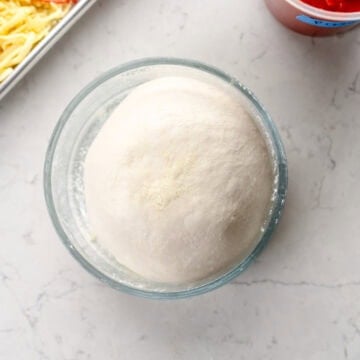
- Shape the dough into a ball, and place into a lidded container or a bowl you can cover with a clean towel or plate. Leave to proof at room temperature for 2 hours, until it has risen by about 50%.
- Dust a lidded sheet pan or a container with a lid that you are going to rise the pizza dough in with rice flour or regular flour, or with semolina flour. I like to use the Ooni stack which is a set of stacking glass bowls.
- Turn the dough out onto a work surface (again I don't usually need to add any flour here but if you do, then go ahead.
- Divide the dough into two pieces, each weighing about 330g. Shape the dough into a tight ball by using the surface tension of your work surface to shape it.
- Transfer the dough to the container you are going to use to rise it in, dust with rice flour, and transfer to the fridge for at least overnight and up to 3 days. The dough will 'flatten' out a little in the fridge but will not rise a ton.
- About an hour and a half before you want to use your pizza dough, remove it from the fridge. Allow to stand covered at room temperature until it has puffed up, and when pressed with a floured finger, the indentation that it leaves slowly springs back most of the way. It should no longer have any cold feeling to it.
- Shape, top, and bake by following the directions below.
SHAPING
- Once the dough is ready to use, place some semolina flour onto a dinner plate or sheet pan. Carefully remove one piece of dough from the container you have risen it in, and place it directly onto the semolina, flipping it so that both sides are covered.
- Transfer the dough to the work surface, adding more semolina if needed. Using your fingers, press in a circle around the edge of the pizza, leaving about a 1-2cm edge. Press down the middle of the ball of dough to gently flatten it off.
- There are lots of ways to stretch pizza but I like to use what I call the 'steering wheel' method - place one hand on the middle of the dough and using the other hand, gently grab the edge of the dough and stretch it out slightly, then turn the dough about 45°. Repeat, going around the edge of the dough 2-3 times until it has stretched out nicely.
- If you would like to, you can carefully pick the dough up and holding it by the edges, move your hands around the sides to use gravity to help stretch the dough further. You can also place it over the backs of your hands to gently stretch it out. This takes practice and you will get better at it with the more pizza that you make.
- You are aiming for a circle of dough that is 12-13" (30-33cm) in diameter, and has a slightly thicker edge.
- Transfer the pizza dough to your pizza peel, giving it a little wiggle to make sure that there are no stuck spots. As you top the pizza, give it a little wiggle every now and then too to ensure that it is not stuck to the peel.
- Top and bake using one of the below methods.
TO BAKE USING A PIZZA OVEN
- Top the pizza as desired. Transfer using the pizza peel to the pizza oven and bake according to the manufacturer's instructions - my dough usually takes about 2-3 minutes in a gas fired oven, or 4 minutes in an electric pizza oven. Again, this will take some practice. Once baked, finish as desired.
TO BAKE USING A BAKING STEEL
- An hour before you want to bake the pizza, place a baking steel or pizza stone into the oven. I prefer to use a baking steel as they are much more durable. Preheat the oven to 500°f / 260°c or as high as your oven will go if it will not reach that temperature.
- Shape and top the pizza as instructed in the shaping section. Using the peel (or if you don't have a peel, the back of a sheet pan will work but you have to be very careful), wiggle the peel to transfer the pizza to the baking steel.
- Bake the pizza for about 5-6 minutes until bubbly and golden brown, and you are happy with the colouring of the crust on the bottom of the pizza. Use the peel to remove the pizza from the oven.
- If you are baking another pizza, make sure that you give the steel enough time to heat up again before cooking your next pizza.
TO BAKE IN THE OVEN.
- About an hour before you are going to bake your pizza, preheat the oven to 500°f / 260°c or however high your oven will go.
- Shape and top the pizza as instructed in the shaping section. You can top the pizza on the sheet pan you are going to bake it on, either directly on the baking sheet or on some parchment paper. While you are shaping the pizza, if you have one, preheat a second baking sheet that stacks with the one with the pizza on it in the oven for about 10 minutes - this helps with the initial burst of heat.
- Top the pizza as desired, then transfer to the oven. Bake for about 15 minutes, until the crust is brown and the cheese and toppings are bubbly.
Notes
Yes, I am asking you to weigh your yeast. I use an Ooni Scale (it is linked in my Pizza equipment page) which is amazing and has both a small and a large scale on it which is perfect for weighing yeast. If your scale is not as accurate, you can use just over 1/4 tsp of yeast.
All of the equipment that I use to make Pizza is linked in my pizza equipment page. Please note that this is not necessary, but it is helpful to have! The main thing that is helpful to have is a pizza peel, however you can easily use the back of a sheet pan to transfer your pizza. I made these pizzas in the Ooni Volt 2 Electric Pizza Oven, we also have a Koda 2 Pro Gas Powered Pizza Oven.
To make same day pizza: The quantities are the same, except use 2.5g of instant yeast. Once the dough has mixed, skip the first rise at room temperature and ball the dough straight from the mixer. Place into a container such as a lidded tray or tupperware dusted with rice flour and semolina. Rise at room temperature for 3-4 hours, until puffy and when lightly pressed with a finger, an indentation is left that slowly springs back. You can also make this version overnight - once balled up and in the container, place into the fridge for up to 24 hours, then remove from the fridge about an hour before you want to make pizza.
I use semolina flour for dusting my dough as it is coarser than regular flour, and doesn't get absorbed as much by the dough. It acts as 'ball bearings' on the dough, allowing it to easily be moved around on the work surface or the peel.
What flour should I use to make Pizza Dough?
There are a few options here. I often use 00 flour, which is finely ground and 'strong' (so it is high in protein). This is a common flour used for pizza making, I like the brand 'caputo' but there are a lot around online or in specialty stores. Bread flour also works great - I have used bread flour and 00 flour interchangeably. Look for one with a high protein content, which means that it will be a nice strong flour and make a lovely stretchy but chewy dough.
Freezing Pizza Dough.
I don't do this often - if I have extra pizza dough I usually just bake it off and then have the pizza for lunch the next day or as leftovers, however I know that people do like to freeze their pizza dough. To do this, freeze after the first room temperature rise when the dough is balled up. To freeze, place the dough on a parchment paper lined sheet pan, then freeze uncovered until solid, about an hour. This helps keep it in shape. Once it is frozen, transfer each dough ball to a ziploc bag and squeeze the air out. Freeze for up to a month. To use from frozen, remove from the freezer and allow to defrost in the fridge overnight, then take out and allow to come to room temperature and puff up before using - this may take a few hours. I have also tested freezing dough after the second room temperature rise but found that the result from the defrosted dough wasn't as nice.